Please Follow us on Gab, Minds, Telegram, Rumble, Truth Social, Gettr, X, Youtube, Instagram
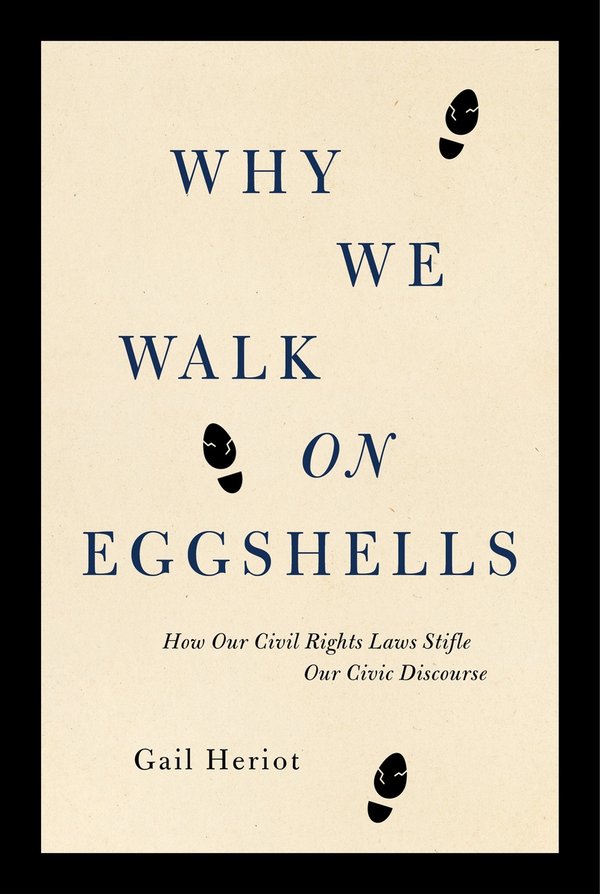
Doral, Florida — In the last decades, we have seen an outburst of woke ideology which proposes racism and sexism as the underlying cause for everything. Gail Heriot explains how this cultural trend has been fueled by civil rights law and policy in her newly-published book: “Why We Walk On Eggshells: How Our Civil Rights Laws Stifle Our Civic Discourse,” New York: Encounter Books, 2026. Gail is a senior fellow at the Manhattan Institute for Policy Research, and a professor emerita at The University of San Diego Law School.
From 2007 to 2025, she was a member of the United States Commission on Civil Rights. In 1996, she co-chaired the successful “Yes on Proposition 209” campaign to amend the California constitution in order to prohibit the state from engaging in preferential treatment based on race or sex. Then in 2020, she repeated her role in the successful campaign to prevent the repeal of Proposition 209.
She is a board member of the National Association of Scholars, and chairwoman emerita of the civil rights practice group at the Federalist Society. Gail and your reviewer both graduated from The University of Chicago Law School, class of 1981.
In her new book, Gail explains how civil rights law and policy has promoted a woke culture with respect to race and sex. The Civil Rights Act of 1964 intended to create a color-blind society, but administrative and judicial misinterpretations since then have enacted policies of affirmative action to provide preferences based on race and sex. She points out that law and public policy have influenced culture.
Gail lays the principal blame for this shift toward race and sex preferences on the practical incentives created by the Civil Rights Act of 1991. It made employment discrimination lawsuits, including those based on harassment, easier and more profitable to bring. Since then, businesses and other institutions have had to conduct training of their employees for “diversity, equity and inclusion.” Dissenting views have been deemed offensive and subjected to woke cancel culture. Observing that the most qualified person should get the job became forbidden.
We should note that this legislation was signed by President Poppy Bush, a globalist RINO who sought to undo the Reagan revolution and as a result lost his bid for re-election.
She also points out that the overwhelming majority of Americans disagree with the central tenet of woke ideology - - that racism and sexism are at the core of the American way of life. Nevertheless, we should consider that as America is inundated with immigrants who do not assimilate, especially Muslims, American exceptionalism tends to be worn down. These divisions are exploited by progressive politicians to energize constituencies opposed to the American worldview.
Gail adds that Critical Race Theory and woke ideology insist on “structural racism” as the defining feature of American life. Both demand “equity,” by which they mean equality of outcomes for racial groups, rather than equality of treatment for individuals. They are treated as deriving their identity from membership in racial and sexual groups, instead of merely as human beings and citizens. On the other hand, most Americans believe that the law should apply the same standards to everyone, regardless of any group identity.
In this book, Gail explains how practical incentives rooted in civil rights law and policy caused the ideas and practices of woke ideology to develop and flourish. As a result, that which had started on college campuses migrated successfully to businesses and other institutions. In doing so, objections from conservatives and libertarians were ruled out of order.
She points out that the diversity project took on cult status on college campuses. Students have been indoctrinated to such an extent that the level of social trust and respect for the rule of law and free speech needed for a free republic has been much reduced. For example, we should keep in mind that Barack Obama was an affirmative action law student and law review editor at Harvard, and law lecturer at UChicago. In addition, Claudine Gay was the affirmative action president of Harvard, and Harvard graduate Ketanji Brown Jackson is an affirmative action Justice on the United States Supreme Court.
Your reviewer reminds you that the American republic does not need to apologize for not being perfect. No human project is perfect, and anyone who asks for perfection is asking in bad faith. If America is so racist, then why do so many blacks and other colored persons immigrate here, and the ones here don’t emigrate? There is no Berlin Wall surrounding America, preventing the oppressed from fleeing from their oppression. People can vote with their feet.
Your reviewer also notes that a color-blind society does not fit the purposes of two groups: (1) progressives who want to lure people into dependency on the welfare state, so that they will vote for the progressive party that created the welfare state; and (2) blacks who grow up without families to invest in their human capital, and therefore are unequipped to compete on a level playing field.
Gail makes three basic points: (1) Good intentions are not enough to make good law and public policy; (2) Attention must be paid to the incentives created by civil rights law and policy following the Civil Rights Act of 1964; and (3) most Americans still oppose race and sex discrimination, no matter which group is victimized. The Supreme Court has finally started ruling in accordance with the American creed, especially in Students for Fair Admissions v. Harvard College (2023). In a 6-3 decision, the court ruled that racial discrimination in admissions is illegal and unconstitutional.
Her book is essential reading for all interested in restoring America’s commitment to equal opportunity for all, and getting past the failed policies of preferential treatment based on race and sex.