Please Follow us on Gab, Minds, Telegram, Rumble, Truth Social, Gettr, X, Youtube, Instagram
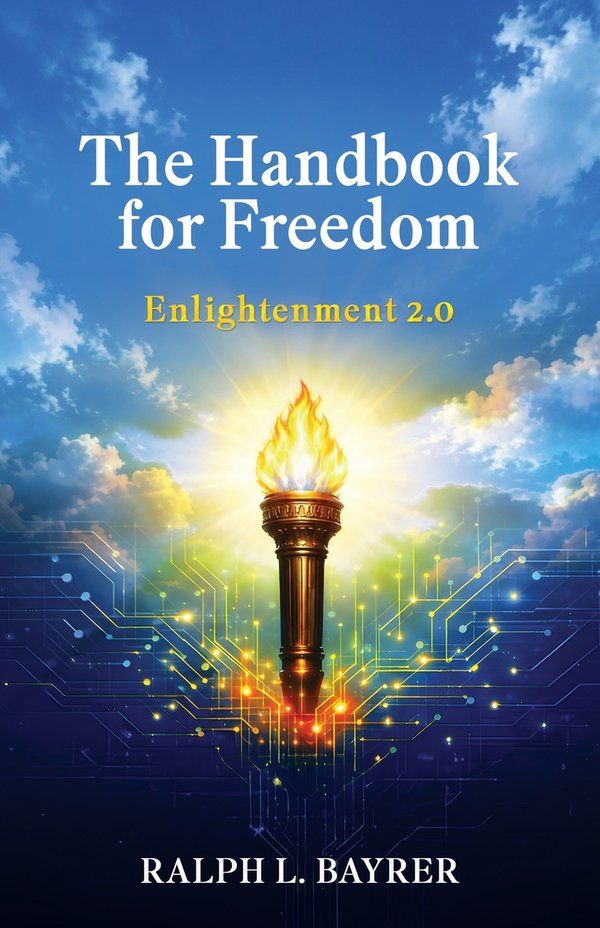
Doral, Florida - Freedom must be be constantly defended. As President Reagan observed, we do not pass it on in our genes. We must explain it and persuade the next generation to carry on the burden of freedom. Ralph L. Bayrer does that in his new book: The Handbook for Freedom: Enlightenment 2.0., Tampa, FL: Gatekeeper Press, 2026. See: https://www.amazon.com/Handbook-Freedom-Enlightenment-2-0/dp/1662976763/ref=tmm_pap_swatch_0.
This book addresses directly the ordinary citizen who is engaged in public life and wants to understand it clearly enough to act. The book’s goal is to equip citizens with an understanding of the principles that sustain a free civilization, so that we may sustain the American republic.
Citizens are not ignorant, but they are overwhelmed. In addition, our teacher establishment, from primary to higher educations, has served mostly as an indoctrination mechanism for principles that undermine free civilization: (1) globalism; (2) progressivism, socialism and communism; and (3) Islamic jihad. As Mayor Mamdani proclaimed, for him the purpose of government is to provide its citizens with dignity.
Instead, this book proposes the supremacy of liberty through the rule of law, reason applied to empirical evidence, and trust in the capacity of ordinary citizens to govern themselves. Free societies thrive when governed without reliance on theocratic dogma, Marxist utopianism or postmodern relativism. As it says on the flag of the Republic of Colombia: “Ordered Liberty.”
The author rests his argument upon a classical liberal, or libertarian, worldview, drawing from the Austrian School of economics: (1) freedom is the first condition of creativity, virtue and progress; (2) individuals are the best judges of their own needs; (3) ideas and institutions must compete to prevail; (4) only freedom generates innovation and prosperity; (5) competition is the best safeguard against market abuse; (6) power must be dispersed and separated; and (7) government is necessary to maintain order, but dangerous when not limited by checks and balances.
He argues that the preservation of self-government will depend on the recovery and application of principles already known: reason guided by empirical evidence, freedom bounded by morality, and compassion informed by realism. Property, liberty and morality arise not from central planning, but from voluntary cooperation under the rule of law. As Friedrich Hayek observed in his book The Constitution of Liberty: “Liberty and responsibility are inseparable.” Voluntary cooperation creates order without coercion.
The author points out that individual liberty under the rule of law is the foundation of moral order:
1. Personal liberty is the starting point of every other form of liberty.
2. Political liberty is inherent in the natural rights of every individual: (1) the right to life and personal safety; (2) the right to believe, speak and act freely; (3) the right to own property and enjoy the fruits of one’s labor; and (4) freedom from state control.
3. Economic liberty is a prerequisite for innovation and prosperity. As Hayek also observed, liberty is not only a moral condition, but also a mechanism for discovery and innovation. Cooperation emerges not through central planning, but through signals from market mechanisms.
Threats to Liberty
Frederic Bastiat observed that: “Everyone wants to live at the expense of the state, but they forget that the state lives at the expense of everyone.” This sentiment leads to government failures: (1) unsustainable public debt; (2) excessive government spending; (3) out-of-control inflation and debasement of our currency; (4) stifling regulations; and (5) failed public services, such as education, healthcare and public transport.
These failures by our governmental institutions are fueled by corresponding failures in human psychology, especially:
1. Sentimentality is essential for a flourishing family life, friendships and volunteering, but free societies demand judgment that is impersonal, based upon empirical evidence, and impartial. Markets function through emotional neutrality. Sentiment, which is indispensable in private life, in public life becomes a channel through which perception is manipulated.
2. Tribalism is another enemy of ordered liberty. Humans are predisposed to divide the world into “us” and “them.” In political action, this manifests itself as hyper-partisanship, identity poitics and zero-sum conflicts. These sentiments are expressed as politics based on ethnic and sexual identity. Political debate becomes not a search for truth, but a contest of narratives aimed at mobilizing support.
3. Envy is rhetoric that frames success as exploitation and wealth as injustice. Thomas Sowell has observed that the old sin of envy has been transformed into the claim for social justice. This outlook undermines the cultural legitimacy of upward mobility and risk taking.
4. Dependency is what the welfare state wants for its citizens. Public benefits become a way of buying votes for the party of welfare. They create constituencies, which can determine elections. Personal responsibility is undermined, household savings decline and resilience weakens. This dependence on Caesar’s bread and circuses contributed to the fall of the Roman Republic.
The very freedom that allows individuals to flourish also exposes a free civilization to ideas and policies that corrode the norms and institutions that make freedom possible.
Preserving Liberty
General Eisenhower observed that in a representative government, “the individual enjoys not only the ultimate power, but also carries the ultimate responsibility.” The American republic has generated exceptional prosperity, expanded knowledge and shown a unique capacity for self-correction. Nevertheless, too many citizens lack an understanding of or appreciation for that achievement. They inherit the blessings of liberty without understanding the norms and institutions that produce them. The survival of a free society requires citizens who understand how the system works, and have the habits of thinking needed to defend it.
The American republic can boast of an exceptional history. It has solved problems that no prior civilization had solved at this scale: coordinating millions mostly peacefully, generating prosperity without plunder, and correcting failures without abandoning the system.
The elements supporting American success are identifiable and tested: (1) secure property rights; (2) the rule of law; (3) freedom of exchange; (4) effective price systems; and (5) constitutional limits on government. Free societies are not flawless, but they are self-correcting.
Preserving freedom requires citizens to cultivate habits of thinking that include respect for empirical evidence and reality, acceptance of tradeoffs, awareness of unintended consequences, and skepticism of governmental power. These habits of thinking are set forth in this book as follows:
1. Empirical thinking requires understanding how the world works. We tend to notice unequal outcomes without tracing the differences in effort, risk or value creation that produce them. We favor short-term benefits while discounting long-term costs. For example: (1) minimum-wage laws reduce entry-level opportunities; (2) higher taxes reduce investment as well as tax revenue; (3) large centralized programs displace local knowledge, control and accountability (like the Live Local Act in Florida); (4) price controls create shortages; and (5) protectionist policies benefit narrow groups while imposing broader costs.
2. The scientific method allows citizens to follow the empirical evidence while remaining open to revision. Citizens must ask what evidence supports this policy? What incentives does it create? What unintended consequences may follow? They must keep in mind that: (1) good intentions do not guarantee good outcomes; (2) incentives work better than encouragement; (3) costs cannot be eliminated, only shifted or hidden; (4) unintended consequences must be considered; and (5) markets reveal information that centralized systems cannot reach.
3. Competition is essential to bring out the best of markets, institutions and governments. It checks error, privilege and stagnation. It is a system for discovering what works. Under competitive conditions: (1) innovators pursue gain by creating value; (2) firms succeed by serving customers; (3) workers advance through skill and effort; and (4) leaders must persuade rather than command. When competition weakens, then motives shift toward rent-seeking and protectionism.
4. Fairness in a free society operates through rules that apply equally to all, consistent processes and reciprocal responsibility. At its core, fairness rests on reciprocity. Citizens benefit from having practical anchors of fairness: (1) fair rules matter more than perfectly equal outcomes; (2) contributions should be valued more than grievances; (3) envy is a poor guide for justice; (4) general rules protect broadly, while special rules invite favoritism; and (5) a society that punishes success will get less of it.
5. Civic virtue must be a disposition sustained by the good character of the citizens of a free republic. Civic virtue is part of the cultural infrastructure of freedom. A high-trust society has less need of government regulation. The citizens must demonstrate: (1) honesty and a disposition to face facts; (2) responsibility for one’s choices; (3) willingness to defer gratification; (4) respect for the rule of law and fair procedures; (5) judge by arguments rather than ethnic or sexual identities; (6) awareness of the unseen consequences of public policy; and (7) goodwill toward fellow citizens.
A free republic endures only because ordinary citizens preserve the principles that make ordered liberty possible. This book reviews the virtues of individual citizens that are needed to preserve self-government, presents the greatest temptations against civic virtue, and concludes that the effort is worth making to preserve the freedom of the American Republic.