Please Follow us on Gab, Minds, Telegram, Rumble, Truth Social, GETTR, X, Youtube, Instagram
I have spent years asking Florida counties for the records that prove they counted your vote correctly. What I got back was fee estimates, exemption letters, a script written by a private lobbying corporation, and, in one hearing, a claim that it would take 18,000 hours to hand over a file that takes under a minute to export.
This is a long one. It has to be, because the officials who run our elections are counting on you not reading the manuals. I read them. Here is what they say, with the receipts.
Your vote is counted from a picture. Not from the paper.
Start with what the vendors say about their own machines, because the whole argument ends right there.
There is not one scanner in use in Florida or California today that reads a mark off the paper. The old machines did. The ES&S Model 100 and the old Diebold and Sequoia units shined infrared light at fixed spots on the sheet and registered whether it bounced back. No picture was ever made. The U.S. Election Assistance Commission’s own glossary draws the line: “Most older optical scan systems use Infrared (IR) scanning technology and ballots with timing marks to accurately scan the ballot. Newer (digital) optical scan systems can also capture images of ballots as they are tabulated.”
Every machine in both states is the newer kind. Florida’s 67 counties run two vendors. The Division of Elections’ own December 2025 map shows 49 counties on ES&S and 18 on Democracy Suite, whose maker the map now lists as “Liberty Vote USA” with a footnote: “formerly Dominion Voting Systems, Inc.” California’s 58 counties, per the Secretary of State’s April 30, 2026 list, run 39 on Liberty Vote (Dominion) ImageCast Central, 13 on Hart Verity, 5 on ES&S, and Los Angeles on its own VSAP Tally system. Every single one is a digital image scanner.
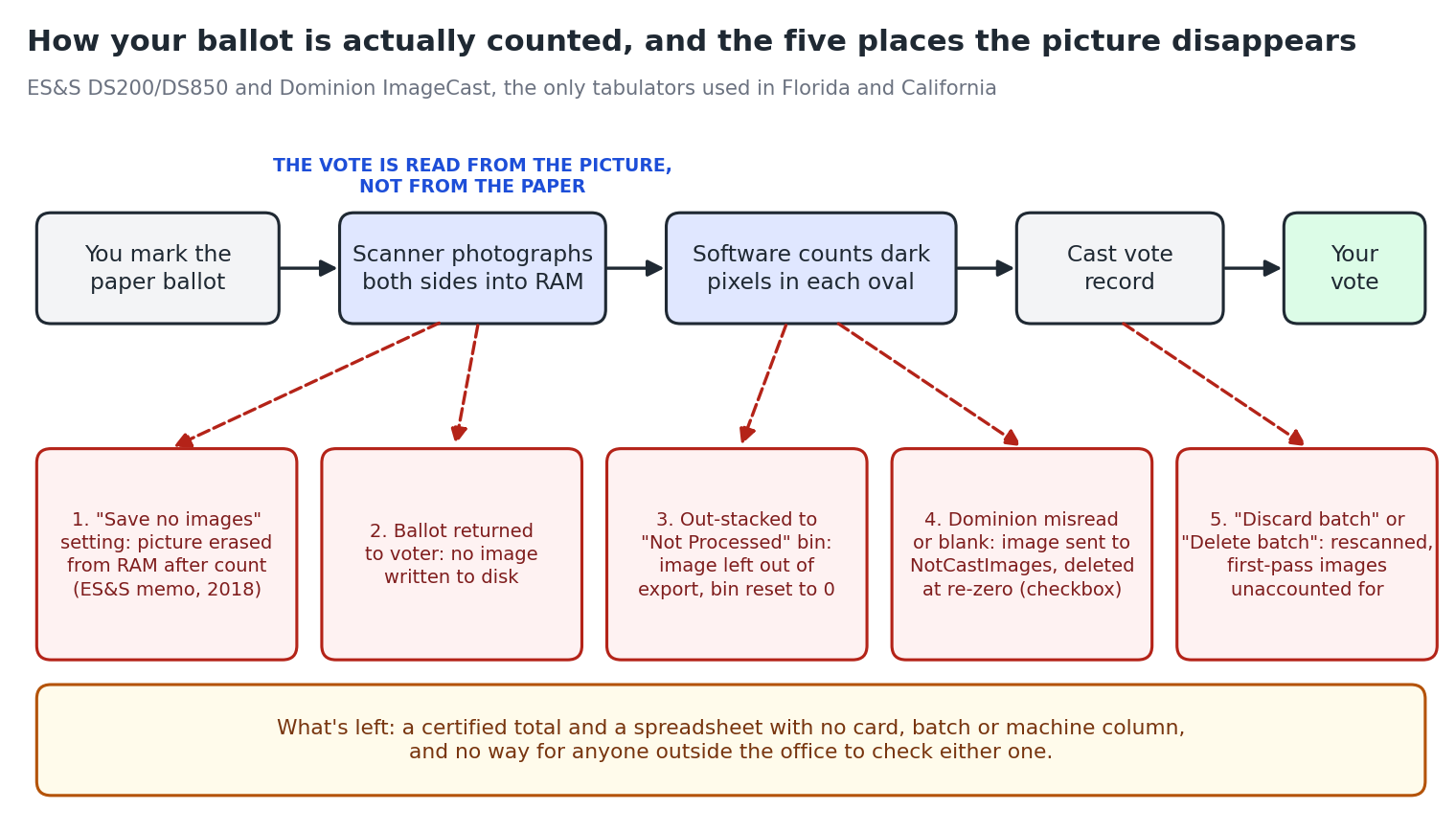
Here is the sequence, and it is the same on all of them. The read head is a contact image sensor, or on Dominion’s central scanner an off-the-shelf Canon document scanner. It photographs both sides of your ballot as the paper moves through. The software then goes to work on the photograph. It finds the timing marks, locates every oval from the election definition, counts the dark pixels inside each oval, and records a vote when the count crosses a threshold that the county set for that election. The vote is derived from the image. There is no second sensor reading the paper.
Don’t take my word for it. Dominion says it in one sentence in its ImageCast Central functionality description: “a complete image is taken of the top and bottom of the ballot as the paper is pulled through the machine. The scanner then passes this image to a software program which looks for markings.” Then: “the machine sums every black pixel for each marking area corresponding to a position on the ballot. If the number of black pixels exceeds the threshold marking defined by the jurisdiction, the mark is considered a vote.”
ES&S calls the DS850 “a high-speed, computerized, digital image-based scanner and tabulator” and says each scan “gathers two images (front and back) and a cast vote record from the ballot.” Its own retention chapter talks about “the processing of the electronic image of the voted ballot, and the assigning of votes.” The EAC’s certificate for the ES&S system Florida runs describes the DS200 as “a digital scanner and tabulator that simultaneously scans the front and back of a paper ballot ... for conversion of voter selection marks to electronic cast vote records.”
Los Angeles County said it under oath. In Rab v. Weber, a published 2023 California Court of Appeal decision, the county’s own declaration reads: “When a ballot is scanned, a digital .jpeg image is created. Tally then processes the digital image to create a cast vote record (CVR).” Hart, the vendor in 13 California counties, defines the term in its state-approved procedures: “digital scan: A process where ballots are scanned and the electronic, or digital, images of the ballot are captured in whole (as opposed to optical scan, where the image is not captured).”
So the photograph is not a byproduct. It is the thing that was counted. The paper is what you marked. The image is what the machine read. When a supervisor of elections tells you “we count the paper,” they are describing a step that never happened.
The word games
Go looking for the phrase “ballot image” in the federal certification paperwork and you’ll find it means two completely different things. Nobody has bothered to fix that. I don’t think that’s an accident.
The 2005 federal voting system guidelines, written for the touchscreen era, defined a ballot image as an “Electronically produced record of all votes cast by a single voter.” That is a cast vote record. A list of selections. Not a picture. By 2007 the drafters admitted the term was already slipping: “A ballot image might be an uninterpreted bitmap image, a transient logical representation of the votes, or an archival record (a cast vote record).” The 2021 guidelines finally use the plain meaning: “Archival digital image (e.g. JPEG, PDF, etc.) captured from one or more sides of a paper ballot cast by an individual voter.” The EAC glossary now carries both definitions on the same page.
The vendors kept the old one alive where it suits them. ES&S’s federal test report glossary still says a cast vote record is “Also referred to as ballot image when used to refer to electronic ballots.” Dominion’s California Use Procedures open with the 2005 definition on page 12 and then spend two hundred pages using “ballot image” to mean the scanned picture.
Why does this matter to you? Because an election office can answer your records request for “ballot images” with a spreadsheet of vote selections and call itself truthful. It can say its system “stores ballot images” and mean XML records. It can say a recount was done “from ballot images” and mean either thing. Florida’s manual recount statute, section 102.166, says a manual recount “consists of a recount of marksense ballots or of digital images of those ballots by a person.” That is the picture meaning. The Division of Elections has never, to my knowledge, published which meaning any county uses when it reports what it kept.
The only way to know what a county actually has is the setting on the machine and the files on the drive. Neither state requires either one to be disclosed. Keep that in mind as you read on.
Florida: a checkbox nobody has to show you
In Florida, whether the photograph of your ballot survives the count is a checkbox.
On November 1, 2018, ES&S put out a one-page memo titled “Ballot Image Information on ES&S Systems.” No addressee. No signature. It has been filed as an exhibit in two Florida lawsuits, and this is what it says: “In the State of Florida, customers can choose three different image storage options during the election programming process. These options are: save no images, save write-in images only, or save all images.”
Read that again. The vendor that runs 49 of our 67 counties tells its customers they may choose to save no images. The same memo describes what the precinct scanner does: “First, the paper ballot is scanned, and an image is temporarily captured into random access memory (RAM).” Then: “the DS200 either writes the ballot image in RAM to the internal USB media or clears the image from the DS200’s RAM depending on the configuration.”
Your ballot is counted from the image, and then, depending on a setting, the image is erased. Gone. Before you have walked back to your car.
The DS200 even has a little icon for it. The operator’s guide describes an “Image Saving Status Indicator”: an orange disk means images are being saved, an orange disk with a red X means they are not. And the choice is baked into the election media weeks before election day. ES&S again: “For the DS200, no changes can be made to the image capture settings without making changes in the election programming software and reburning all media.” So the decision to keep or destroy the record of every vote in your county is made by whoever codes the election definition, and it is printed on a configuration report that no Florida statute requires anyone to publish.
The Dominion counties are no better off. The ImageCast Central saves images of accepted ballots, but every ballot that stops the scanner, whether for a blank, an overvote, an ambiguous mark or a misread, goes to a folder the manual names as C:\dvs\project\NotCastImages. When the machine is re-zeroed the operator gets a checkbox: “Also delete un-cast ballot images.” Nobody in Florida is required to record whether that box was ticked.
The State has known all of this for years and chose to do nothing. In 2018, the plaintiffs in Fox v. Detzner told a federal court that “only sixteen (16) Florida counties using digital scan voting equipment actually preserve all ballot images,” and named them: Sarasota, Manatee, Leon, Collier, Alachua, Walton, Columbia, Hendry, Dixie, Bay, Gilchrist, Hernando, Taylor, Bradford, Volusia and Wakulla, “with Polk and Broward saving write-ins only.” The same filing said “at least 34 Florida counties using digital scan voting equipment do not preserve ballot images or preserve write-in ballots only.”
In 2020, a group led by State Senator Geraldine Thompson sued eight supervisors of elections, including Pinellas County’s Julie Marcus, and the Secretary of State to force them to keep the images. Their complaint alleged that “the electronic voting equipment cannot and does not count the ballots without first making the ballot image files,” and that “as many as twenty-seven (27) counties affirmatively preserve the digital ballot images.” That August the parties agreed to shelve the case through the general election. The News Service of Florida reported that the announcement “said 32 of the state’s 67 counties routinely preserve such images.”
Sixteen, twenty-seven, thirty-two. Those are the only numbers the public has ever been given, and every one of them is a litigant’s allegation or a press release. Not an inventory. The State has never published one.
And how did the supervisors respond to being sued to keep the images? Not by keeping them. By going to Tallahassee to make sure they never had to. Among the Florida Supervisors of Elections’ stated legislative priorities for the 2021 session, quoted in the State’s own appellate brief: “Designation of paper ballots as the actual public record, not digital ballot images.” The First District Court of Appeal threw the case out on venue alone in July 2021 and said in so many words that the merits “have not yet been adjudicated.” The Florida Supreme Court declined to hear it that December. The question of whether Florida counties must keep the record their machines counted from has never been decided, and the people who run those machines lobbied to make sure the answer would be no.
Federal law does not leave the question open. The U.S. Department of Justice’s July 28, 2021 guidance on the 22-month retention statute, 52 U.S.C. 20701, states: “The materials covered by Section 301 extend beyond ‘papers’ to include other ‘records.’ Jurisdictions must therefore also retain and preserve records created in digital or electronic form.” A county that clears the image from RAM after counting from it is destroying a federal election record within seconds of creating it. Every voter. Every election.
Florida: what the records actually show
I have spent years prying records out of Florida counties. The productions tell their own story, and it is not the one on the Division of Elections’ website.
Hillsborough County. My request PRR 701 produced the county’s Unity Election Reporting Manager system logs and its Electionware audit event reports for the 2018, 2020 and 2022 generals. The 2018 log runs 520,057 lines. The 2020 log runs 402,561. The 2022 log runs 584,288. Number of entries in any of them that mention a ballot image: zero. The Electionware audit reports came as 1,010, 866 and 841 pages of scanned images with no text layer, and they don’t mention ballot images either. There is no configuration report for any DS200 or DS850 in the production. So the image setting the county used in three federal elections is unknown from its own records.
What the logs do show is other things. The 2018 log carries 2,244 “Votes exceed ballots” warnings between October 15 and November 9. The 2020 log carries 9,349 of them. The county says its two-card ballot generated the warning every time a batch of B cards was tabulated, which is plausible, except that 3 of the 2018 warnings and 18 of the 2020 warnings are dated before the county’s own vote-by-mail tabulation window opened. The 2020 admin audit shows five “Election Deleted” entries fired within 25 seconds on September 9, 2020, for elections named “ESS-14-Testing,” “Heather’s Primary Election,” “Hillsborough Demo Ballot,” “Hillsborough ESS Demo Election” and “2018 Primary.” What those deletions removed, the county did not say. And the 2020 Electionware report has no cast vote record export entry at all. No 2020 CVR for Hillsborough exists on any drive I hold.
The only 2020 Hillsborough images I have are 316 grayscale JPGs from three boxes, and each box opens with a card printed “Target Card” and “Clear Ballot.” Those are not the ES&S tabulator’s images. They are rescans from a separate audit system. The pictures the county actually counted from in November 2020 are, as far as its own productions show, gone.
Sarasota County. The county’s DS-DE 40 report to the State for the 2022 general lists its blank ballots as “17, 284,” typed as text into a numeric box. Its 2022 cast vote record export has exactly 17,284 rows in which every contest cell is empty or reads “undervote.” For 2020 the same county reported 9,907 blank ballots. In 2018 it reported 26. Twenty-six. Nothing in the State’s reports asks how a county’s blank-ballot count went from 26 to 9,907 to 17,284 across three general elections. The State has not asked.
Broward and Miami-Dade. Sarasota is not the outlier, and the two biggest counties show why. Broward County reported 181,721 blank ballots on its DS-DE 40 for the 2018 general election. That is not a typo. It is the county’s own certification that 181,721 voters walked in, or mailed in, a ballot with no vote for anything on it, in the year Florida recounted the governor’s race and a U.S. Senate seat. Broward reported 56,915 blank ballots in 2020 and 60,165 in 2022. Miami-Dade’s official EL45A results report for November 3, 2020 shows 1,166,203 ballots cast and, on the very next line, “BALLOTS CAST - BLANK 68,604,” which the report itself computes as 5.88 percent of the county’s turnout. The report breaks it down: 12,861 on election day, 19,638 by mail, and 36,105 at early voting sites. The State’s own 2020 overvote and undervote report carried no blank figure for Broward or Miami-Dade at all. Both cells read “NA.”
Do you really believe 181,721 Broward voters went to the trouble of voting and then voted for nobody?

Now look at what happened in 2022. Across most of the state the blank-ballot count collapsed to a rounding error. Hillsborough went from 21,884 to 48. Palm Beach went from 20,313 to 59. Orange went from 22,719 to 42. Lee went from 22,661 to 15. Polk went from 12,566 to 24. Collier went from 7,269 to 23. Miami-Dade went from 68,604 to 1,784. Broward went from 56,915 to 60,165. Pinellas stayed at 14,972. Sarasota went up, to 17,284. Nobody in the Division of Elections has offered any explanation for why a condition that hit tens of thousands of voters per county in 2020 hit a few dozen two years later in most large counties, and more than sixty thousand in Broward. Voters don’t change that much in two years. A tabulator’s Blank Ballots setting can change it overnight, and Florida does not require anyone to disclose that setting.

The cast vote record exports. I hold 31 Florida cast vote record exports covering 29 county elections in 22 counties. Not one has a column for card, sheet, page, ballot style, batch, vote method or tabulator. They are a record number, a precinct, and the contests. You cannot tell from any of them which machine read the ballot, whether it was a mail ballot or a precinct ballot, or whether the record was adjudicated. And the row counts don’t always match what the county certified. Pinellas 2020 has 564,280 rows against 564,284 ballots cast, and 15,517 no-vote rows against 16,804 reported blanks. Pinellas 2022 has 423,837 rows against 424,549 ballots, with 928 record numbers missing from the sequence. Miami-Dade 2022 has 716,230 rows against 716,322 in one county report and 715,393 in the State’s workbook. Palm Beach’s 2022 general export shows 248 no-vote rows against 59 reported blanks. Polk, Collier, Lee, Flagler, Jackson, Hamilton and Lafayette each show row counts a few ballots off from ballots cast.
A few ballots off may be a duplicate, a jam, a re-fed sheet. It may be something else. Nobody in Tallahassee can tell you which, because the record that would settle it, the image, is the record Florida lets counties throw away.
The State’s own audit reports. The Division of Elections publishes a report on overvotes and undervotes after each general election. The 2022 report announces that the accuracy of the manual audits was 99.99 percent and the accuracy of the automated audits was also 99.99 percent. It also says, in a footnote it has repeated since 2018: “No Florida county, to the Department’s knowledge, codes their tabulators to alert voters of undervotes other than blank ballots.” The 2018 report describes “polling place practices in some counties that place overvoted or blank ballots in emergency bins for later duplication.” Emergency bins are where ballots go when they are NOT scanned. A ballot duplicated later is scanned as a brand new sheet with a brand new image, and the original is never imaged at all.
The same 2022 report can’t keep its own count straight. Page 19 says 51 counties conducted a manual audit and 11 an automated one. The finding on the next page says 42 and 10. Its table for Nassau County reports “1 more ballot scanned into the audit sys due to DS200 jam.” That is the level of reconciliation Florida calls a 99.99 percent result.
Pinellas County. My own county’s supervisor, Julie Marcus, was a named appellant in the Thompson case, one of the eight who argued that the voters trying to preserve the images had sued in the wrong courthouse. My Chapter 119 action against her office over vote-by-mail records, case 26-004464-CI, is pending as I write this. Pinellas is one of the eleven counties the State says used an automated audit in 2022. An automated audit is an audit of ballot images. If the county audits from images, it has them. If it has them, it can produce them. It has not.
2024: the number disappears
For every general election through 2022, the DS-DE 40 form each county filed with the State carried a Box 4 for duplicated ballots and a Box 5 for blank ballots, with the instruction: “Enter the number of ballots that were blank. A blank ballot contains no selected vote targets.” Those two boxes are where the Broward, Miami-Dade, Hillsborough and Sarasota numbers above came from.
In February 2024, before the presidential election, the Division of Elections revised the form. Both boxes are gone. The new form, “DS-DE 40, rev. 02/2024,” goes from Box 3, registered voters, straight to Box 4, which now asks whether the county’s ballots are printed in English only. The instructions were rewritten to say: “For the purposes of this form, a blank ballot (i.e. a ballot without any selections made in any contest) is also considered an undervote.”
Think about that. The one number that showed 181,721 in Broward and 68,604 in Miami-Dade was never corrected. Never explained. It was folded into a different category and deleted from the form. The State’s February 2025 report on the 2024 general election, 21 pages of findings on audits and overvotes, has no statewide blank-ballot count, because the counties were no longer asked for one.
When the numbers get embarrassing, Tallahassee doesn’t fix the machines. It stops collecting the numbers.
The association that writes the denials
The supervisors aren’t even answering records requests on their own anymore.
Here is the background. In 2026 I was a qualified candidate for the United States Senate on the August 18 primary ballot, and after the primary a contestant of that election under section 102.168. The records I asked every county for were the ones a candidate needs to verify the count: logic and accuracy test records, tabulator audit logs, vote-by-mail reconciliation records, the cast vote record and image exports.
On August 5, 2026, Florida Supervisors of Elections, Inc. sent every supervisor in the state an email from its staff titled “FSE Guidance Regarding Pending Public Records Requests.” It came from Angela Weeks-Samanie and was copied to David E. Ramba, who signs the association’s correspondence as its Executive Director, and to Rachel Kruse. Attached was a Word document, labeled attorney work product, that drafted the response the supervisors should send to my pending requests. The draft told them to charge a service fee before even preparing an estimate, to treat the records as sealed under section 101.5612 until the contest period ran out, and to claim the critical infrastructure exemption in section 119.0725(2) for test deck timing marks, equipment serial numbers and activity logs.
Who is FSE Inc.? Most Florida voters have never heard of it. It is a private Florida corporation, formerly the Florida State Association of Supervisors of Elections, whose members are the 67 supervisors and whose money comes from their offices. The dues are paid out of YOUR county budget. Sarasota County’s Board of County Commissioners payment request dated September 10, 2020 shows $3,130.32 to “Florida Supervisors of Elections” for “2020-2021 FSE Dues - Ron Turner,” approved by the supervisor himself, with the note “Formerly known as: Florida State Association of Supervisors of Elections (FSASE).” Its address, 120 South Monroe Street, Tallahassee, is the address the Florida Bar lists for Ramba Law Group LLC. Ramba’s own law firm. Section 119.01(3), Florida Statutes, says that when an agency spends public funds on dues to a private entity, that entity’s financial, business and membership records about the agency are public records.
So FSE Inc. is a lobbying and coordinating body for 67 constitutional officers, paid for by taxpayers through their offices, run out of a private law office, and now writing the denial letters.
It knows it is subject to the records law, because it has said so. In May 2024 The Justice Society asked FSE Inc. for its communications with the supervisors and with state officials about, among other things, “Restricting Public Records Requests” and “Blank Ballots,” and for its invoices to and from VR Systems, the vendor whose software sits at the center of the June 23 question I’ll get to below. FSE’s office replied on May 15, 2024 that it was “in receipt of your request” and would “evaluate this for response and any costs.” On May 22, 2024, Ramba wrote back over his signature as Executive Director: the request would take “at least eight (8) hours of research by our office staff at a billing rate of $80 per hour and at least one (1) hour of review by legal counsel at a billing rate of $250 per hour,” payment in full up front, closed in thirty days without it.
That is the association that two years later drafted the fee-first script the counties are now using. And when I asked its longtime general counsel for that guidance email this September, he replied that he does not represent it.
Read it for what it is. A private corporation, with its executive director on the copy line, instructed 67 constitutional officers on how to keep a candidate on the ballot from seeing the records that would verify his own election, and to run out the clock on his contest while doing it. Collier County released the email on September 4, 2026, apparently by accident, under the subject line “FW: EXTERNAL: STAFF ONLY - FSE Guidance Regarding Pending Public Records Requests.” When I then asked every county for its copy, Flagler, Walton, Hendry, Suwannee, Santa Rosa, Lafayette, Wakulla, Liberty, Franklin, Washington and Orange produced it. A corporation with no custodial duty under Chapter 119 is writing the denials, and the custodians are signing them.
The denials rarely use the word no. Collier invoiced $579.14 for audit logs and then withheld them under section 119.0725 anyway. Flagler demanded a $16,343.04 deposit for device audit logs and $5,038.08 more for its audit images. Lee County estimated $25,086 for 282,624 ballot image pages and a 12,000-page machine log, and answered “no responsive documentation” for the reconciliation logs and the integrity checks. Several counties wrote that the records were sealed until the contest period ended, which is the only period in which a contestant can use them. Florida’s courts have said for forty years that an unreasonable delay in producing a public record is a denial of it, and that a fee not tied to the actual cost of the extensive use of resources is not authorized by section 119.07(4). A pay gate a candidate cannot clear, or a delay that outlasts the deadline for using the record, is a refusal. It doesn’t matter what the letterhead calls it.

And there is a simpler way to say all this. The tabulators generate these records automatically. Producing them costs a flash drive and an afternoon. Georgia posts five million images for anyone to download. Dane County, Wisconsin has done it for a decade. A government that spends more effort keeping its audit records from the public than it would spend handing them over is not protecting the election. It is protecting itself from the audit. People and governments who hide the records that would prove the count are, until they produce them, hiding whatever the records would show.
Where the count and the picture part ways
Election officials in both states like to tell you the image count and the ballot count “should match.” Sometimes they do. The manuals describe at least six ways they don’t, and every one of them is a place where a ballot can be counted with no image, or an image can exist with no counted ballot, and nobody outside the office will ever know.
1. The blank ballot. ES&S defines a blank ballot as one that does “not have any votes, [has] votes only for withdrawn candidates, or [has] been marked with a non-standard marking device, or [has] been marked improperly (for example, circling a candidate rather than filling in the oval).” Read the third and fourth clauses again. A voter who used the wrong pen, or circled the name, has under this definition cast a BLANK ballot. On a DS200 set to “Always Accept,” that ballot is counted with zero votes and reported in the precinct export as “BALLOTS CAST – BLANK.” Florida’s results feed to the State, form DS-DE 138, has no field for it. And in a county set to save write-in images only, a blank ballot has no write-in, so no image is saved. It is a counted ballot with no picture and no vote. Hillsborough reported 21,884 of them in 2020. Sarasota reported 17,284 in 2022. Broward reported 181,721 in 2018.
2. The returned ballot. When a DS200 questions a voter about an overvote and the voter takes the ballot back, it is not cast, not counted and not, as far as any manual I hold describes, imaged to disk. The event log records it as “Voter Rejected Overvote.” A poll worker can also use “Override Ballot Rejection” to force acceptance of a ballot the machine would otherwise refuse. The one DS200 audit log reprint in my files, from a Florida unit on November 8, 2022, records 1,097 voting sessions started, 1,033 completed, 49 ballots “Automatically rejected Unreadable mark,” and exactly ONE “Ballot images stored” event for the entire day. Whether that entry means one image or one session’s worth is a question ES&S has never answered.
3. The out-stacked ballot. On the central scanners that count Florida’s mail ballots, a ballot the machine cannot read goes to a “Not Processed” bin. The DS850 guide says the cast vote records of those ballots “are selected for exclusion from the collection process” and that the export carries images “of any scanned ballot that was not out-stacked.” The operator can then “remove the ballots from the bin and reset the top bin quantity to zero, before you save the batch.” What happens to the first-pass image of a ballot that was scanned, out-stacked, pulled, and reset to zero is not described anywhere. In Bastrop County, Texas, the same ES&S scanner logged 82 ballots cleared from that bin in 2022 and 74 in 2024, and those ballot numbers do not appear in the image export.
4. The un-cast image. Dominion’s central scanner runs about 340 image checks on each sheet. “If any check fails, the software will report a misread.” A misread never becomes a cast vote record. Its image goes to NotCastImages, the paper is set aside for duplication, and the duplicate is scanned as a new image. So one counted ballot can have two images, or, if the un-cast images were deleted at re-zero, none.
5. The deleted batch. Every system has a way to remove a batch so it can be rescanned. ES&S calls it “Delete the Current Batch.” Dominion calls it “Discard Batch.” Clear Ballot calls it “DeleteBox.” Whether the images go with the data depends on the system and the county’s procedure. Williamson County, Texas, logged two “Delete Batch” actions and a “Clear Results” on one central scanner on election day 2022, and the ballot numbering just kept going.
6. The duplicate. Florida law, section 101.5614(4)(a), requires a “true duplicate copy” of a damaged mail ballot and of an overvoted mail ballot where “there is a clear indication on the ballot that the voter has made a definite choice.” The duplicate is what gets scanned. Hillsborough reported 7,221 duplicated ballots in 2020 and 3,889 in 2022. Sarasota reported 3,588, 3,633 and 3,162 across three generals. Each duplicate is a hand-made ballot whose image is the only image, and whose original was never imaged by the tabulator at all.
Then there is the question of what you are even counting. ES&S stores “each side of each ballot sheet ... as a separate image.” The DS200 public counter ticks once per ballot, or once per first page of a multi-page ballot. On a two-sheet ballot the public count is half the sheet count and a quarter of the faces. Dominion, depending on a setting, writes one file per ballot or three. Riverside County’s precinct scanners in June 2024 were set to write three, and every unit’s image counter is exactly three times its ballot counter. Shasta County’s were set to write one, and the counters match. Any official who tells you the image count “matches” the ballot count without saying whether they counted ballots, sheets, faces or files is telling you nothing.
The machines keep independent counters for exactly this reason. Dominion’s design document lists three: the poll record, the “scanner hardware paper count (mechanical count),” and the “image processing paper count (software count),” and says “all three totals should agree before a set of ballots for a poll is accepted.” ES&S’s Electionware reports a “Total Ballots” figure defined as the “total number of ballot images included in results data for each piece of media.” These reconciliation reports exist. The machines the counties already own generate them. Not one Florida county has produced one to me, and no Florida statute requires the reconciliation to be done, recorded or disclosed.
California: keep it, seal it, then shred it
California took a different road to the same place. Florida lets the image die in RAM. California requires it to be kept, forbids anyone from seeing it, and then orders it destroyed.
Until September 2024, California had no statute that mentioned ballot images at all. The Secretary of State’s office told counties in a July 2021 bulletin that retention of election records “includes digital ballot images,” then pointed them to the vendors’ Use Procedures for “whether or not your jurisdiction’s voting system has this capability.” The State’s own chief counsel issued a memo in September 2022 on preserving 2020 election materials that does not mention digital images once. Its message to counties: the retention period for the 2020 general had ended on September 3, 2022, litigation hold letters “alone ... are insufficient to ignore California state law,” and the materials “must remain sealed and must be destroyed at the end of the retention period. State law does not authorize any discretion.”
SB 1328 finally put the words in the code. Since September 25, 2024, Elections Code section 17601 requires that for any federal election, “All ballot images” be kept “stored and unaltered, for 22 months from the date of the election.” So far so good. Then read subdivision (c): if no contest or specified criminal prosecution has been filed within those 22 months, “the elections official shall have the backups destroyed.” The statute does not say may.
On September 19, 2026, an urgency bill, SB 1418, added that the electronic media holding the images “shall be stored in a sealed container.” So the image of every ballot cast in California is now, by statute, a record the county has to create and seal, that nobody may copy, and that the county has to destroy on a schedule.
The Secretary of State’s view of what you, the voter, may do with it is on the record. In its October 2024 overview of SB 1328, the Office of Voting Systems Technology Assessment wrote: “The Secretary of State is of the opinion that while a ballot image can be viewed by an observer during the post-election audit or recount processes, copies shall not be provided to a requestor nor posted on the internet.” The same memo lists the voting system’s “Logs” among things that are “not public information ... and shall not be released.” Cast vote records may be released, in the State’s opinion, but only “in a secure, locked PDF format,” and “the frequency of report release is at the discretion of the jurisdiction.”
A locked PDF of a spreadsheet is not a record anyone can analyze. It is a picture of a record, handed over in place of the record, by the same office that will not hand over the picture of the ballot.
In April 2026 the chief counsel wrote again, this time about a form letter counties had received demanding preservation of the November 2024 and November 2025 election records. The answer: the federal 22-month statute is “a provision exclusively for the United States Attorney General to obtain records, not any other party,” the office was “unaware of any election contests” filed within the window, and the 22-month period for the November 5, 2024 presidential election “ends on September 5, 2026.” The attached chart lists “All ballot images” under “Mandatory destruction (at end of retention period).” That date has passed. If California’s counties followed their own chief counsel’s instruction, the images from the 2024 presidential election were destroyed three weeks ago.
What the vendors’ state-approved procedures say about all this tells you everything, because the State sends counties to those procedures for guidance. I pulled every currently approved version. Not one of them cites section 17601, 17602, 15209 or 17301. Dominion’s procedures for the system 39 counties use are dated June 18, 2024, three months before SB 1328 existed, and the Secretary of State made them “mandatory” in March 2025 without updating them. ES&S’s procedures for its five California counties say image saving is a county option set in Electionware, and add that “memory cards are not deemed to fall within the purview of these Elections Code sections.” Hart’s precinct scanner saves images only if a box labeled “Save scanned images to vDrive” is checked; its central scanner lets an operator “permanently delete a ballot from the batch,” and its performance guidance tells counties they can delete tasks “that contain large amounts of data, such as ballot images.” Los Angeles County’s procedures require 22-month retention of “VBL, BMG, and Tally event logs” and do not name the Tally ballot images at all, even though the county told a court the images are what Tally counts from.
So in California the statute says keep all images, the State says show them to no one, the vendor manuals say saving is optional or deletable, and the chief counsel says destroy them at 22 months. Which of the 58 counties actually held the November 2024 images on September 5, 2026, in what form, and whether an image of a ballot that stopped the scanner even counts as a “ballot image” under section 17601, are questions no state office has answered in writing.
California: what the scanner logs say
The few California scanner logs that have escaped into public hands prove the deletions in the manuals are not hypothetical.
Riverside County. Under records request 24-3006, the county produced 24 redacted tabulator logs from its June 4, 2024 recall election, 20 from ImageCast Central units and 4 from precinct scanners. On April 30, 2024, five of the central scanners logged, within six minutes of each other, “Deleted previously scanned un-cast image files.” Across the election the central units logged 55 “Tabulator State Reset” events, 91 “Deleted Open Batch” events, 36 “Rejecting batch” events and 63 entries that read simply “Skipped.” Twenty-six lines name files in a NotCastImages folder. What the five deletions removed, and whether the 26 not-cast images survived the election, the county has not said. The precinct units were set to “Encrypt images: 1,” so even the images that were saved are unreadable without the county’s key.
San Diego County. The county’s Dominion audit log for the November 2022 general records 7,672 result files deleted from the database and 6,470 changed to “Rejected.” Not one of those entries mentions images. Fourteen thousand result-file events with no statement of what happened to the pictures those results came from is exactly the gap the reconciliation counts in Dominion’s own design document exist to close. The county did not close it.
Shasta County. Shasta is the counterexample, and it shows how easy honesty is. Its precinct scanners were set to “Number of rescans after misread: 1” and “Save front, back and AuditMark image as one: 1,” and on every unit the “Number of images” counter equals the “Number of ballots cast” counter. Each ballot produced one image file, and the two counters agree. That took a setting, not a statute.
Los Angeles County. The largest election jurisdiction in the country scans ballots to JPEG before it does anything else. Its VSAP 4.0 procedures, approved this March, say: “Ballot scanning may be conducted prior to election night as part of the preparation process. This step is essential to capture ballot images in advance, ensuring they are ready for tabulation once results reporting begins on election night.” The Court of Appeal in Rab v. Weber held that scanning ten days early was lawful because “machine reading includes scanning.” So the county holds a complete image library of every ballot before a single result is reported. Pennsylvania’s Deputy Secretary of State testified in the Honey case that Los Angeles is among the jurisdictions that “already post CVRs or ballot images without issue.” Whatever Los Angeles posts, it is not the images. The county’s own procedures don’t even list them among the records to be kept, and the Secretary of State says copies “shall not be provided to a requestor nor posted on the internet.”
My own records requests to Los Angeles County, filed as a candidate on June 10, 2026, asked only for the exported cast vote record reports, and said in so many words that the request “does not seek voted ballots, ballot images, or vote-by-mail or provisional identification envelopes,” because I understood those to be sealed under section 17301. That is the position a requester is forced into in California. You ask for the spreadsheet and stipulate that you know better than to ask for the evidence.
Other states already do this
The excuse you’ll hear in both states, when anyone bothers to offer one, is that ballot images are too sensitive, too big, or too new to treat as public records. Other states have been treating them as public records for years, at scale, and the sky has not fallen.
Georgia made “scanned ballot images created by a voting system” public records by statute in 2021. Since 2024 the Secretary of State has been required to post 200-dpi images of every scanned ballot by the second Friday after the election. The state’s Ballot Image Library holds one file from each of its 159 counties for the November 2024 general election, 5,297,268 images in all. Anyone can download them. Want higher resolution? Ask for 600-dpi rescans and watch the scanning. Georgia runs the same Dominion equipment that 18 Florida counties and 39 California counties use.
Maryland audits every statewide general election by “an automated software audit of the electronic images of all ballots cast in the election,” run on Clear Ballot software independent of the voting system. The State Board says the practice “eliminat[es] chain of custody issues by using securely stored ballot images, rather than voted paper ballots.” Maryland runs ES&S, the same vendor as 49 Florida counties, and the State Board maintains a public ballot portal online where the audited images can be viewed.
Colorado’s Court of Appeals held in 2011 that the TIFF images from Aspen’s election were not “ballots” and were open under the state records act once files with identifying marks were set aside. The Legislature then wrote images into the definition of a ballot and set a schedule: sealed from 45 days before the election through certification, then open to inspection with identifying marks redacted.
Michigan’s Macomb County has kept tabulator images and their matching cast vote records since November 2021, and since the November 2025 election posts a scan of every ballot online through a “Ballot Verifier” tool. The county clerk’s position is that the images were already public records under a 2010 Attorney General opinion.
Wisconsin’s Dane County has posted its ballot images since 2016. A 2021 Elections Commission staff memo states that “Wisconsin state certification requires ballot images to be saved for every ballot processed by a tabulator on election day.”
Pennsylvania’s Supreme Court held in April 2026 that cast vote records are not “the content of ballot boxes or voting machines” and are open under the Election Code, and has sent five image and ballot cases back to the Commonwealth Court to be redone in that light. The Department of State directs counties to keep federal election images for 22 months as a condition of reusing memory cards.
Texas, since a 2023 amendment, requires images of voted ballots, if a county keeps them, and cast vote records to be opened for inspection the day after the final canvass.
There is a counter-tradition. Arizona’s appellate courts read a 2017 statute requiring images to be protected “at least as” well as paper to bar their release entirely, and in August 2026 extended that bar to cast vote records. New York’s highest court held in 2019 that electronic ballot copies are sealed “voted ballots.” Washington and Utah are similar. But even there, when the Arizona Senate subpoenaed Maricopa County’s 2020 records, the court held the secrecy statutes “do not prohibit disclosure of voting information to another part of the government,” and the county inventoried and delivered all 2,089,563 ballot images. The images existed, were counted, and were produced. That is the standard even the secrecy states hold to. Florida cannot meet it because it lets the images be erased. California cannot meet it because it orders them destroyed.
And the state with the loudest public-records rule just showed what happens without one. Fulton County, Georgia, told investigators it “does not have scanned images of all the 528,777 ballots counted during the Original Count” in November 2020, that the memory cards from scanners Dominion loaned it for the recount “have since been redistributed and used in subsequent elections,” and that the images it could produce came from the recount, not the count. An investigator told the State Election Board that “ballots can be scanned and tabulated without capturing ballot images.” Georgia fixed its law in 2021. Florida has been told the same facts since 2018 and has fixed nothing.
Sunday, June 23, 2024
The images are one half of the record. The other half is the file that says who asked for a ballot in the first place, and in 2024 Florida showed us what it does with that one too.
A vote-by-mail request in Florida is supposed to require identity verification. Section 101.62 says the request must carry the voter’s Florida driver license number, state ID number or the last four digits of the Social Security number, and the supervisor must check it against the registration record before a ballot goes out. In the Pinellas County request file for the August 2024 primary, produced under Chapter 119, 219,675 vote-by-mail requests carry a single request date: Sunday, June 23, 2024. The office was closed. Among them were roughly 1,500 records of voters whose addresses are exempt from disclosure under section 119.071(4)(d), judges, law enforcement officers and others, processed with no verification trail. The same signature appeared again in the file before the November general, with a block of requests dated September 9, 2024. Miami-Dade’s request records showed the same kind of anomaly. Both counties refused to produce the underlying records that would show who entered the requests, from what terminal, with what verification.
On August 20, 2024, primary election day, I was standing outside polling places talking to voters who were showing up with vote-by-mail ballots they told me they never requested. They were going to the Supervisor’s office asking for copies of their own requests and being told no.
I reported all of this that summer to the people whose job it is to care. To the Dhillon Law Group, which was then the Republican Party’s election-litigation counsel of choice. To the Republican National Committee’s Election Integrity Team, which opened a ticket on August 20, 2024, asked for affidavit signature pages and photos of the ballots and envelopes, and then went quiet. To the United States Department of Justice. And to Florida’s Office of Election Crimes and Security, the unit the Governor created in 2022 to investigate exactly this. The office’s director was briefed on it personally. The office did nothing that anyone has been able to find a record of. In 2025 he was hired into the Justice Department, under Attorney General Pam Bondi and Assistant Attorney General Harmeet Dhillon.
The county’s story has changed depending on who was asking. To me, and to the courts hearing my 2024 election contests, the Supervisor’s office contested the finding. To the Sixth Circuit State Attorney, in a referral file opened March 11, 2025 and closed April 8, 2025 as “solved in house,” the Supervisor’s general counsel described it in writing as a “database/software issue,” and the county attorney’s office called it a known vendor issue requiring a patch. Stop and think about what that means. A county told a prosecutor that its own voter registration system generated or altered a quarter of a million ballot requests on a Sunday, and the prosecutor closed the file in four weeks without a public word. When the vendor’s explanation came up in a related records case, the vendor, VR Systems, moved to intervene in August 2026 to keep it sealed.
So the county’s current position is that it was a glitch. Fine. If it was a glitch, the records that show it are the most important election records in the county, and there is no exemption for them. Instead, when I asked for the vote-by-mail request records as a candidate in 2024, the county’s attorneys stood up in circuit court on August 29, 2024 and told the judge that producing them would take about 18,000 hours. At the rates the same office was quoting me in writing that year, $48.29 to $88.60 an hour depending on the request, that is somewhere between $870,000 and $1.6 million, for a system export the vendor, VR Systems, confirmed runs in under a minute. Eighteen thousand hours is nine years of one employee’s full-time work, and the county said it with a straight face to keep a candidate from seeing a file before the deadline to contest his election ran out. In 2026 the same records drew a fee estimate of $5,548.93 per election, a demand that I sign an oath the statute does not require of a candidate, a motion to have me declared a vexatious litigant, and a bench ruling that the burden was on ME to prove the fee unreasonable before a single page had been reviewed. The 2024 contests themselves were dismissed as untimely, three days past a ten-day deadline, without any court ever reaching the June 23 file.
And one more fact about those courts. The county’s own 2024 production lists, among the exempt voters whose vote-by-mail requests carry the June 23, 2024 and September 9, 2024 dates, the circuit judge who dismissed my 2024 contest and who sat on my 2026 records case until her retirement, denying, without notice to either side, a motion asking her to step aside. A judge whose own ballot request is in the file at issue was ruling on whether the file could be seen.
I do not know how many Floridians had a ballot requested in their name without their knowledge in 2024, or how many of those ballots were cast and counted. Nobody does. The number is in records that two counties, a state attorney, a vendor and a circuit court have so far combined to keep closed. And in my experience, the reason to keep a number closed is usually the number.
The people who knew
None of this is news to the people now running federal election enforcement. They litigated it.
In April 2022, Kurt Olsen filed a federal suit in Arizona on behalf of Kari Lake and Mark Finchem asking the court to bar electronic tabulators from the November election. The theory was the one I have spent this whole article documenting: the machines count from data the public cannot see, their logs and images are the only record of what they did, and those records were being withheld or not kept. The district court dismissed the case, and in December 2022 sanctioned Olsen and co-counsel about $122,000 for bringing it. He went on to try Lake’s contest of the 2022 governor’s race, in which the court noted that ballots the tabulators could not read “could be deposited in Door 3 of the tabulator and counted later after duplication by a bipartisan adjudication board.” That is the same out-stack and duplicate path I described above, with the same un-imaged original. In the parallel attorney general contest that December, the county produced nine ballot images under court order and the court sealed them as “private ballots not to be made available to the public.” Harmeet Dhillon’s firm was in the Arizona courts in the same cycle on the Republican side of the same fights, over signature verification, Election Day tabulator failures and the county’s handling of the records.
Dhillon is now the Assistant Attorney General for Civil Rights. Olsen took a senior counsel post at the Justice Department in 2025. Between them they know, in detail and from the inside, that Arizona’s appellate courts have since closed ballot images and cast vote records to the public entirely, that Maricopa destroyed its 2020 ballots on schedule, and that Fulton County never had the images from its 2020 original count. They know the Department’s own July 2021 guidance says the 22-month federal retention statute reaches “records created in digital or electronic form,” a sentence that, read literally, makes every Florida county that clears the image from RAM a violator.
What has the Department done with that knowledge? In January 2026 it sent the FBI to seize 600 boxes of Fulton County’s 2020 records, on an affidavit a federal judge later found “defective in some respects,” with statements about ballot images the judge called “troubling.” It has sued states for their voter rolls. On the machines and their records, the docket is empty. No county has been charged under section 20701 for failing to keep the digital records the Department’s own guidance says the statute covers. The Election Assistance Commission has not been asked to test what happens to images of returned, out-stacked and un-cast ballots, which its own certification reports show has never been tested. Florida has heard nothing from Washington about whether a tabulator setting labeled “save no images” can be squared with federal law, and California has heard nothing about whether a statute ordering the images destroyed at 22 months, enforced by a Secretary of State who forbids copies, is what Congress meant by preservation.
So here is where we stand, three presidential cycles after these questions were first raised. The machines are the same machines. The DS200 firmware Florida ran in 2020 has been through minor revisions; the image-save checkbox is right where it was. Dominion’s 5.19 procedures, made mandatory in California in 2025, don’t mention the retention statute passed in 2024. The Division of Elections’ 2018 footnote about blank ballots was still the footnote in 2022, and in 2024 the State stopped asking for the number. Nothing in the hardware, the software, the certification regime or the state statutes has changed in a way that makes the count more verifiable than it was in 2020.
What HAS changed is the posture of the people running the elections. In 2020 the Florida supervisors were being sued to keep the images. In 2021 they asked the Legislature to declare the images not a public record. In 2024 the State deleted the blank-ballot box from the form. In 2026 their association circulated a script for denying a Senate candidate’s request for the records of his own primary. That is not a security program. It is a concealment program, and it gets more coordinated every cycle.
Florida loves to call itself the gold standard of election administration. The Governor said it after 2020 and the supervisors have repeated it ever since. The claim rests on a fast count and a quiet certification. It does not rest on anyone having checked. A state whose counties may erase the record the machines counted from, whose blank-ballot count was 21,884 in one county and 181,721 in another and is now not collected at all, whose audit reports can’t agree with themselves on how many counties were audited, and whose supervisors take their records-request scripts from a private lobbying corporation, is not the gold standard of anything except message discipline. The standard for an election is that its result can be verified from its records by someone who does not work for the people who ran it. On that standard Florida is not ahead of Georgia or Maryland or Dane County, Wisconsin. It is behind them, and it is spending your money to stay there.
And a question for the Trump administration, asked with respect. The President has said for five years that the 2020 election was rigged. His Justice Department seized Fulton County’s 2020 records in January. Fine. Then answer this: what made 2022 different? What made 2024 different? What makes 2026 different? Same machines. Same vendors. Same image-save checkbox. Same counties erasing the same records. Same association writing the same denials. If the system was capable of producing a fraudulent result in 2020, it was equally capable in 2022, 2024 and 2026, because nothing about the system changed. You cannot have it both ways. Either the machines and the records can be trusted, in which case release the records and let us check, or they cannot, in which case every election run on them since is under the same cloud, including the ones you won. If one was fraudulent then all of them are suspect until the records say otherwise, and the records are sitting on county servers right now, or they were until somebody hit delete. The data speaks for itself. It only needs to be produced.
HB 437: the fix that passed 111 to 0 and died in a drawer
Don’t let anyone tell you the Legislature hasn’t had the chance to fix this. It had it this year.
In the 2026 session, the Florida House took up CS/HB 437, a public records bill sponsored by the Government Operations Subcommittee with Representatives Andrade, Campbell, Mooney and Plasencia. It was not radical. It required agencies to acknowledge a public records request promptly and respond in good faith. It required a written cost estimate before an agency could charge you. It tightened the rules on custodians, fees and penalties. And it required courts to assess costs and fees against agencies that break the law, which is the only thing that has ever made a records custodian move. In other words, it went straight at the pay gates and the stalling I have described in this article.
It cleared four House committees. On March 4, 2026, the full House passed it 111 to 0. Not one Democrat and not one Republican voted against it. That is as close to unanimous as Tallahassee gets.
Then it went to the Senate, was referred to the Rules Committee, and on March 13, 2026, nine days later, it died there without a hearing. The Senate companion, SB 770, filed by Senator Rouson, died in committee the same day. Nobody had to vote against it. Nobody had to explain. The chair simply never put it on the agenda, and the session ended.
Ask yourself who benefits from a public records bill dying quietly in Senate Rules the same spring that FSE Inc. was drafting fee-first denial scripts for 67 supervisors. Then ask your state senator, by name, whether he or she asked for that bill to be heard. The answer is a public record too.
What the Legislature owes you is bigger than HB 437. The bill would have made it easier to pry records loose one request at a time. What Florida actually needs is to stop making you ask. Every auditable election record, in its original electronic format, posted online after certification, free, for anyone to download: the ballot images with identifying marks redacted, the cast vote records, the tabulator configuration reports and event logs, the native results exports, the blank, duplicate and out-stack reports, and the vote-by-mail request and return files with the protected fields removed. Georgia does it. Maryland does it. Dane County and Macomb County do it. The files already exist. The only thing standing between you and them is a Legislature that let a 111-to-0 bill die in a drawer, and the only thing that changes that is you making the drawer more expensive than the vote.
What Florida and California owe you
None of this needs new equipment. The scanners already take the picture. The software already keeps the counters. The reconciliation reports already exist as menu items. What is missing in both states is the will to require that the picture be kept and shown.
Florida should amend chapter 101 to require every county to configure its tabulators to save ALL ballot images, to publish the configuration report for every unit before the election, to keep the images and the tabulator event logs for 22 months as federal law already requires, and to produce them under chapter 119 with voter-identifying marks redacted, the way Colorado and Georgia do. The Division of Elections should publish, for every election, the county-by-county image setting, the “BALLOTS CAST – BLANK” count, the duplicate count, the out-stack count and the image file count, so the figures a county certifies can be checked against the figures its machines recorded. It should put Boxes 4 and 5 back on the DS-DE 40 and publish the 2024 blank-ballot figures it stopped collecting. The Legislature should say in plain words that guidance from a private association is not a statutory exemption, and that a supervisor who signs one as a denial is personally on the hook under section 119.12. And the supervisors’ 2021 request to declare paper the only public record should be rejected by name.
California should repeal the destruction mandate in sections 17601(c) and 17602(c) and replace it with a public inspection right that opens after certification, with the same redaction rules. The Secretary of State should withdraw its opinion that image copies “shall not be provided to a requestor” and its instruction that cast vote records be released only as locked PDFs. It should require every vendor’s Use Procedures to cite and comply with sections 17600 through 17603 before approving them, and require every county to file, before destroying anything, an inventory of what it holds, including NotCastImages folders, deleted-batch reports and re-zero logs.
And every state should be required to post the auditable electronic records of every election on the supervisor’s or registrar’s website, free of charge, within days of certification, for the full retention period. That means the ballot images with identifying marks redacted, the cast vote records, the tabulator configuration reports and event logs, the results and canvass reports in their native export formats, the blank, duplicate, out-stack and batch-discard reports, and the vote-by-mail request and return files with the protected fields removed. Georgia already posts its images. Dane County and Macomb County already post theirs. The machines already generate every one of these files. The only work involved is copying them to a web server, which is less work than a county now spends drafting fee estimates and exemption letters.
These are not the supervisors’ records. They are OURS. They are generated by public employees, on public equipment, bought with public money, in the course of the one official duty those employees exist to perform, and Article I, section 24 of the Florida Constitution says so in plain words. A public record does not become the agency’s private property because the agency would rather not have it examined. A record the public has already paid to create should never be sold back to the public at a price set by the office that would rather it stayed unread.
Put it in plain terms. Suppose you own a business, or run a department, and you ask the people who work for you to show you the records proving they did the job you pay them for. Suppose they say no. Or suppose they say yes, but first you have to pay them again, somewhere between twenty thousand dollars and $1.6 million, and sign a form, and wait until the deadline for doing anything about it has passed, and accept that a trade association you have never heard of will decide what you are allowed to see. Nobody would run a business that way for a week. That is how the administration of elections runs in Florida right now, and the fee estimates I have received in 2026 alone, from Flagler’s $16,343 for device logs to Lee’s $25,086 for images and a machine log, are the receipts. Pinellas’s 18,000-hour estimate from 2024 is the one that belongs in a frame.
What you can do about it
I can file records requests and lawsuits until I run out of money, and they have made sure that day comes fast. What I cannot do is be 67 counties’ worth of voters showing up at once. That part is you. Here is what actually moves these people.
1. File your own public records request. It takes ten minutes. You do not need a lawyer and you do not need a reason. Email your county Supervisor of Elections (every office has a public records address on its website) and ask for the following, for the most recent election, as existing records in native electronic format under section 119.01(2)(f):
- The DS200/DS300 configuration report for each precinct tabulator, and the DS450/DS850/DS950 image-save setting for each central scanner, showing the “Save Ballot Images” choice and the blank, unreadable and overvote handling.
- The tabulator event or audit logs.
- The “BALLOTS CAST – BLANK” count by precinct from the Electionware export, the duplicate-ballot count, and any Not Processed or out-stack report.
- The cast vote record export and the ballot image export, or a written statement that no images were saved and under whose authority.
- Any guidance the office received from Florida Supervisors of Elections, Inc. about how to answer records requests since July 1, 2026.
Ask for an itemized estimate before any charge is incurred, and say you do not authorize charges above $25 without written approval. If they quote you a fee, ask for the employee classification and actual hourly labor cost behind it. If they claim an exemption, section 119.07(1)(e) requires them to cite the specific statute by number and name the custodian. Make them do it in writing. Then send me the response. I am building the 67-county file.
2. Call Tallahassee and ask one question. Secretary of State Cord Byrd and Division of Elections Director Maria Matthews decide what the DS-DE 40 form asks for. Call the Division at (850) 245-6200 and ask why Boxes 4 and 5 were removed from the form in February 2024 and when they will be restored. Ask for the 2024 blank-ballot count by county. You will not get an answer. Write down who told you that, and the date, and post it.
3. Ask your county commission why it pays FSE Inc. dues. Your county’s Board of County Commissioners approves the supervisor’s budget, and that budget includes dues to Florida Supervisors of Elections, Inc. Go to the next meeting, sign up for public comment, hold up this article, and ask the commissioners whether they know their taxpayers are funding an organization that drafts denial letters for public records requests. Ask them to condition next year’s dues on FSE Inc. producing its records under section 119.01(3).
4. Demand a referral under section 838.022. Official misconduct in Florida is a third-degree felony, and it includes “concealing, covering up, destroying, mutilating, or altering any official record or official document” and “obstructing, delaying, or preventing the communication of information relating to the commission of a felony.” A supervisor who erases the image the machine counted from, or who signs a lobbying association’s script to withhold the audit records from a candidate, has some explaining to do under that statute. Send a written complaint to your State Attorney, to FDLE at (850) 410-7000, and to the Office of Election Crimes and Security at [email protected]. Keep a copy. When they close it “in house,” ask for the closed file.
5. Show up at logic and accuracy testing and the canvassing board. Both are public meetings under Florida law. Bring a notebook. Ask the supervisor, on the record, whether the tabulators are configured to save all ballot images for this election, and ask to see the configuration report. Ask how many ballots were duplicated and how many were out-stacked. Ask for the reconciliation between the mechanical paper count, the image count and the cast vote record count. The answers are either yes and here it is, or they are not. Either one is worth knowing before the votes are counted, not after.
6. Make your state senator answer for HB 437, then hand them the next bill. Start with the one that already passed. Ask your senator, in writing, whether they asked Senate Rules to hear CS/HB 437 after it passed the House 111 to 0, and whether they will co-sponsor it when it is refiled for 2027. Then ask them to file or co-sponsor a bill that (a) requires every Florida tabulator to save all ballot images, (b) requires the images, cast vote records, configuration reports, event logs and native results exports to be posted online in their original electronic format within 14 days of certification, free, with voter-identifying marks redacted, (c) restores blank and duplicate ballot reporting on the DS-DE 40, and (d) states that guidance from a private association is not an exemption under chapter 119. Georgia’s SB 202 is the model. Send them this article, the HB 437 vote, and the Georgia statute. A senator who will not answer the first question has told you everything you need to know about the second.
7. Share this with someone who runs a business. The people who understand this fastest are not political people. They are anyone who has ever had to prove to a customer, an auditor or the IRS that they did what they said they did. Ask them what they would do if an employee told them the records of their own work would cost $1.6 million to see. Then ask them why they accept it from the people who count their vote.
8. Subscribe, share, and send me your county’s answers. Every response a county sends you is a public record too, and a pattern across 67 counties is evidence in a way that one county’s letter is not. I read every one.
The answer to “did the image count match the counted ballots” is knowable. The machines were built to answer it. Florida and California have arranged their laws so that nobody has to. That only works if nobody asks.
Leave a comment below and share your thoughts
Sources
Vendor documents
- ES&S, “Ballot Image Information on ES&S Systems,” Nov. 1, 2018; Exhibit 16 to the Verified Complaint in Thompson v. Lee, Leon Cir. Ct. No. 2020-CA-001238, and Plaintiffs’ Exhibit 6 in Fox v. Detzner, N.D. Fla. No. 4:18-cv-00529; see also AUDIT-USA white paper on how digital ballot images are saved on the DS850 (Exhibit 8)
- ES&S FAQ, “Do ES&S tabulation systems create cast vote records (CVRs) and ballot images?” (retrieved Sept. 26, 2026)
- ES&S DS200 Operator’s Guide, firmware 2.30.0.0 (July 18, 2019), pp. 32, 35, 39, 41, 107, 123, 133, 159-163; ES&S System Overview EVS5000, Operator Guide for DS200 (2013), pp. 18, 26, 67-68, 173
- ES&S DS850 Operator’s Guide, EVS5200 (Feb. 26, 2014), pp. 8, 47, 80-81, 93, 100-101, 110
- ES&S Electionware Vol. IV Deliver and Vol. V Results, EWARE 5.0.6.0 (May 2021), pp. 18-19, 26, 78, 121, 138, 144 (EVS5200 editions: Vol. IV Deliver, Vol. V Results)
- ES&S Unity 3.4.1.0 California Use Procedures, Rev. 5.0 (June 22, 2016), pp. 210-211 (Hillsborough County’s production copy); ES&S EVS 6.3.0.2 California Use Procedures, Rev. 1.2 (Feb. 2023), pp. 128-129, 192-193, 218, 311, via the Secretary of State’s voting technology vendors page
- Dominion, 2.03 ImageCast Central Functionality Description 5.13 (Apr. 1, 2021), pp. 7, 23, 28, 32-35, 42; ImageCast Central User Guide 5.13 (Apr. 20, 2021), pp. 24, 32-34, 47-48, 54; 2.02 System Overview 5.13 (Apr. 20, 2021), pp. 23-27 (Colorado Secretary of State postings of the Democracy Suite 5.13 documentation)
- Dominion, Democracy Suite California Use Procedures 5.10-A (Aug. 5, 2021) §§ 4.5.6, 7.9, 10.10.2, App. F.3.1, via the Liberty Vote vendor page; Democracy Suite 5.19 Use Procedures (June 18, 2024) §§ 7.3, 7.9.1-7.9.3, 10.9, App. F.2.1.1
- Hart Verity 3.2.1 California Use Procedures, Doc. 6644-004 J, pp. 74, 195-196, 398-404, 509
- Los Angeles County VSAP Tally Use Procedures 3.0 (Apr. 1, 2022) and 4.0 (Mar. 16, 2026), pp. 6, 17, 49, 109, 151
- Clear Ballot ClearCount Election Administration Guide, pp. 47-48, 60, 65; Reporting Guide, pp. 11, 14-15
Federal certification records
- EAC Certificate and Scope of Conformance, ES&S EVS 6.1.1.0 (July 27, 2020); Certification Test Report, EVS 6.1.1.0
- EAC Certificate and Scope of Conformance, ES&S EVS 6.4.0.0; Certification Test Report, EVS 6.0.0.0 v4.0
- EAC Certificate and Scope, Dominion D-Suite 5.17 (Mar. 16, 2023); Test Report, D-Suite 5.17 Rev. 03; Test Report, D-Suite 5.5 Rev. A
- EAC Certificate and Scope, Clear Ballot ClearVote 2.3 v1.2 (Oct. 31, 2022); Test Report, ClearVote 2.3; Test Report, ClearVote 1.4 Rev. C (Jan. 29, 2018)
- EAC Glossary of Election Terms, pp. 11, 19, 62
- VVSG 1.0 (2005), Vol. I, App. A; VVSG 2.0 (Feb. 10, 2021), App. A, pp. 266, 269; TGDC draft recommendations (Aug. 31, 2007), App. A
- U.S. Department of Justice, “Federal Law Constraints on Post-Election ‘Audits’” (July 28, 2021), pp. 2-3; DOJ press release
Florida
- Thompson v. Lee, Leon Cir. Ct. No. 2020-CA-001238, Verified Complaint (July 1, 2020) ¶¶ 48, 50, 68
- Scott v. Thompson, No. 1D20-2445 (Fla. 1st DCA July 19, 2021); Florida Supreme Court No. SC21-1346 (Dec. 14, 2021) and Respondent’s Jurisdictional Answer Brief appendix (Nov. 15, 2021), JAA 004-009, 020-022, 055
- Fox v. Detzner, N.D. Fla. No. 4:18-cv-00529, ECF 28 at 3 and ECF 32 at 15 (Dec. 26, 2018)
- Tampa Bay Times (Allison Ross), Aug. 25, 2020; News Service of Florida on WLRN (Jim Saunders), Aug. 25, 2020
- Florida Division of Elections, voting systems in use (”Voting Systems by Vendor,” rev. Dec. 2025); Report on Overvotes and Undervotes and Post-Election Audits, 2022 General Election (Feb. 15, 2023); 2018 and 2020 reports and the Mar. 3, 2023 addenda (2018 report data, 2020 summary data); 2024 General Election Summary Report (Feb. 15, 2025)
- Florida Statutes: § 101.5614, § 101.62, § 102.166, § 119.01, § 119.07, § 119.12, § 838.022; Article I, section 24, Florida Constitution
- Hillsborough County production PRR 701 (Unity ERM system logs EL68A and Electionware audit event reports, 2018, 2020 and 2022 generals; DS-DE 40 workbooks and Conduct of Election reports, 2020 and 2022; Logs Dates and Activities Guide); Hillsborough November 2020 Clear Ballot images (316 files)
- Sarasota County production (Conduct of Election reports 2018-2022; DS-DE 40 workbooks 2018, 2020 and 2022)
- Florida cast vote record exports, 31 files covering 29 county elections in 22 counties, inventoried in the author’s records
- Florida State University et al., “100% Retabulation Audits: 2022 Primary and General Election Audit Data and Ballot Images from Leon County” (report 23-LCI-002, Mar. 5, 2024)
- Miami-Dade County, Official General Election Results, Nov. 3, 2020, Report EL45A (run 11/13/20), p. 1 (”BALLOTS CAST - BLANK 68,604”)
- Broward County DS-DE 40 filings, 2018, 2020 and 2022 generals (181,721; 56,915; 60,165), in the county-by-county blank and duplicated ballot compilation built from the 67 counties’ DS-DE 40 workbooks, and the county-versus-state blank ballot comparison, 2020 and 2022
- Florida Division of Elections, Form DS-DE 40, rev. 02/2024 (”Instructions” and “Form” sheets)
- Florida Supervisors of Elections, Inc., “FSE Guidance Regarding Pending Public Records Requests,” Aug. 5, 2026 (Angela Weeks-Samanie, cc David Ramba and Rachel Kruse), with attachment “AWP.DraftEmailtoSOEs.8-4-2026.docx”; produced by Collier (Sept. 4, 2026), Flagler (Sept. 11), Walton (Sept. 13), Hendry, Suwannee, Santa Rosa, Lafayette, Wakulla, Liberty, Franklin, Washington and Orange in the PRR-2026-FSE series; Ronald Labasky reply of Sept. 9, 2026
- Pinellas County Supervisor of Elections 2024 vote-by-mail request file production (219,675 requests dated June 23, 2024; September 9, 2024 block); Sixth Circuit State Attorney file SA25-147 (opened Mar. 11, 2025, closed Apr. 8, 2025); Gleason election contests 24-003717-CI and 24-003995-CI (Fla. 6th Cir.), 2D2024-2687 and 2D2024-2688, SC2025-1102; Gleason v. Marcus, 26-004464-CI (Fla. 6th Cir.); VR Systems motion to intervene, Liccione v. Bartlett, 25-007207-CI (Aug. 14, 2026); FDLE criminal complaint EI 320359 and May 7, 2026 preservation notice
- Gleason v. Marcus, Chase and Smith, 24-003717-CI (Fla. 6th Cir.), hearing of Aug. 29, 2024 (county counsel’s 18,000-hour estimate) and Plaintiff’s Motion for Sanctions for Misrepresentation and Fraud Upon the Court (Oct. 4, 2024); Pinellas SOE fee estimates of June 27 and Sept. 4, 2024 and July 7 and July 29, 2026; RNC Election Integrity Team ticket ZG7Y3V-V4NWN (Aug. 20, 2024)
- The Justice Society, public records request to Florida Supervisors of Elections, Inc. (May 9 and 15, 2024); FSE acknowledgment (May 15, 2024); David E. Ramba, Executive Director, fee response of May 22, 2024 ($80/hr staff, $250/hr counsel); Sarasota County BCC Payment Request, Sept. 10, 2020 ($3,130.32, “2020-2021 FSE Dues,” PEID #340080, “Formerly known as: Florida State Association of Supervisors of Elections”); Government-in-the-Sunshine Manual (2024), p. 66, s. 119.01(3); Florida Bar member profile, David Eugene Ramba, Bar No. 44687, Ramba Law Group LLC, 120 S. Monroe St., Tallahassee
- Lake v. Hobbs, D. Ariz. No. 2:22-cv-00677 (dismissed Aug. 2022; sanctions order Dec. 2022), aff’d (9th Cir. 2023); Lake v. Hobbs, Maricopa Cnty. Super. Ct. No. CV2022-095403 (Dec. 24, 2022); Hamadeh contest, Mohave Cnty. Super. Ct. No. CV2022-01468 (Dec. 23, 2022 minute entry)
California
- California Elections Code § 15101, § 15209, § 15360, § 17301, § 17600, § 17601, § 17602, § 17603; SB 1328 (Stats. 2024, ch. 605); SB 1418 (Stats. 2026, ch. 341)
- Secretary of State county clerk memoranda (CCROV), from the advisories to county elections officials index: #21103 (July 2021), #22216 (September 2022), #23143 (December 2023), #24121 (June 2024), #24220, “OVSTA: Senate Bill 1328 Overview” (Oct. 18, 2024), #25022 (March 2025), #26085 (April 2026)
- Secretary of State, Office of Voting Systems Technology Assessment, “Voting Technologies in Use by County,” as of Oct. 10, 2025 and Apr. 30, 2026
- Rab v. Weber, No. C093916 (Cal. Ct. App., 3d Dist., May 26, 2023); Citizens’ Oversight, Inc. v. Vu (2019) 35 Cal.App.5th 612
- Riverside County, records request 24-3006, ImageCast Central and Precinct logs, June 4, 2024 recall election
- San Diego County, Dominion audit log, November 2022 general election
- Shasta County, ImageCast Precinct logs (application 5.10.10.3)
Other states
- Georgia: O.C.G.A. § 21-2-493, § 21-2-500, § 50-18-71; State Election Board Rule 183-1-12-.13 and Rule 183-1-15-.02 (GPB, July 9, 2026); Georgia Ballot Image Library; Secretary of State November 2024 Ballot Image Audit Report; Pitts v. United States, N.D. Ga. No. 1:26-cv-00809, Docs. 22-2, 30-1 and 108; Curling v. Raffensperger, N.D. Ga. No. 1:17-cv-2989, Docs. 964, 1705, 1868
- Maryland: Election Law § 11-309; State Board of Elections, Ballot Audit Plan (automated); Maryland Public Ballot Portal
- Colorado: Marks v. Koch, 284 P.3d 118 (Colo. App. 2011); C.R.S. § 24-72-205.5
- Michigan: Attorney General Opinion No. 7247 (May 13, 2010); Macomb County Clerk, Ballot Verifier; Votebeat, Mar. 6, 2026; Bridge Michigan; Bailey v. Antrim County, No. 357838 (Mich. Ct. App. Apr. 21, 2022); J. Alex Halderman, Antrim County analysis (Mar. 26, 2021), pp. 41, 50
- Wisconsin: Elections Commission staff memo, Mar. 2, 2021
- Pennsylvania: Honey v. Lycoming County (Pa. Apr. 2026); Department of State Directive 2 of 2026 (Apr. 6, 2026), p. 6
- Texas: Elec. Code § 1.012(f); Secretary of State Advisory 2024-05
- Arizona: A.R.S. § 16-624, § 16-625; AUDIT-USA v. Maricopa County, 254 Ariz. 536 (App. 2023); Santa Cruz County v. AUDIT USA, No. 2 CA-CV 2024-0328 (Ariz. Ct. App. Oct. 20, 2025); Hudson v. Heap, No. 1 CA-CV 25-0730 (Ariz. Ct. App. Aug. 11, 2026); Maricopa County v. Fann, No. CV2020-016840 (Feb. 25, 2021); Maricopa County, “Correcting the Record” (Jan. 2022), pp. 9, 23
- New York: Matter of Kosmider v. Whitney, 132 N.E.3d 592 (N.Y. 2019)
- Hawaii: Cushnie v. Chief Election Officer (Haw. Sept. 6, 2022)
- Verified Voting, the Verifier (retrieved Sept. 27, 2026)
- Florida Legislature: CS/HB 437 (2026), Public Records (passed House 111-0, Mar. 4, 2026; died in Senate Rules, Mar. 13, 2026); SB 770 (2026) (Rouson; died in committee Mar. 13, 2026); House bill page, CS/HB 437