Please Follow us on Gab, Minds, Telegram, Rumble, Truth Social, GETTR, X, Youtube, Instagram
The familiar red-and-blue county maps that dominate election night coverage are increasingly misleading. In the 2026 midterms, no-party-affiliation and independent voters (NPAs) once again formed the largest or most decisive bloc in key contests, overriding traditional partisan geography. Exit polls show that these voters broke toward Democrats on the strength of personal economic concerns, producing a Democratic sweep of both the House and Senate and exposing a serious strategic miscalculation by Republicans who treated the map as destiny. As a three-decade NPA, I have always been keenly aware of this fact.
National exit polls (NBC, AP Voter Poll, and consortium surveys) found that the economy and cost of living were the top issues for roughly 39 percent of voters, well ahead of democracy or other topics. Nearly nine in ten said the cost of living was a crucial or major factor. About three-quarters rated the economy as poor, and 60–65 percent said President Trump’s policies had made conditions worse or blamed him directly for high prices. Voters were more than twice as likely to report that their own finances had deteriorated as to report they had improved. On the question of who they trusted more to handle the economy, Democrats held a clear edge (approximately 43 percent to 37 percent for Republicans).
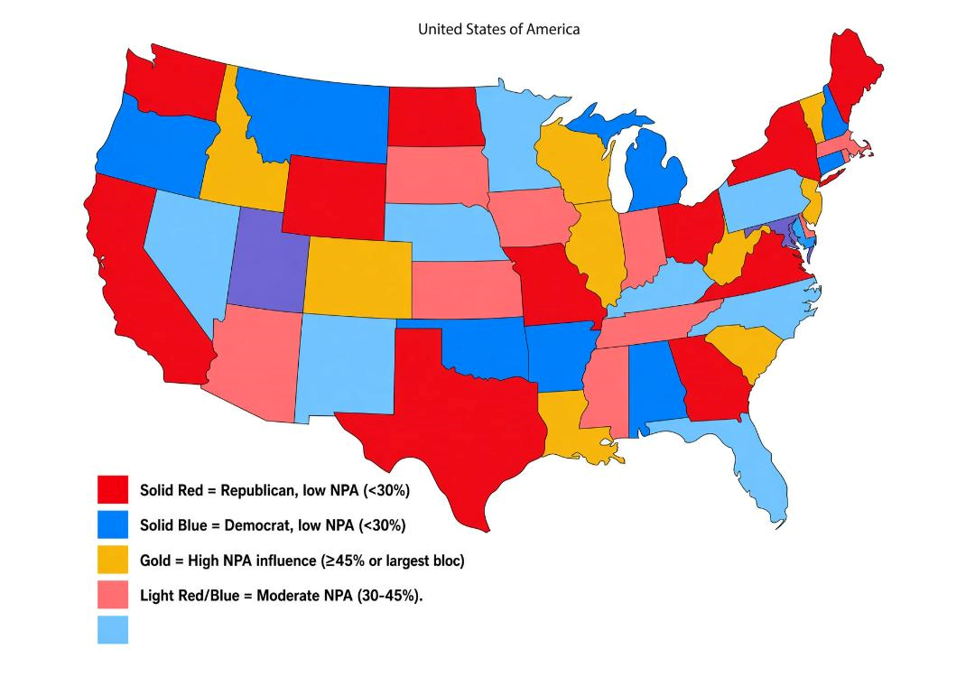
Independents—roughly one-third of the electorate—translated their economic dissatisfaction into votes. Independent women backed Democratic House candidates by about 59 percent to 34 percent; independent men did so by roughly 51 percent to 43 percent. Combined with Trump’s 38 percent approval rating among voters (the lowest for a sitting president on Election Day in nearly two decades), this independent shift powered Democratic gains even in states Trump carried by double digits in 2024. Seats flipped or were held in Texas, Kansas, Ohio, Iowa, South Carolina, and elsewhere, areas that conventional red-blue maps would have painted as safely Republican.
Florida illustrated the same dynamic in microcosm. Byron Donalds (R) defeated David Jolly (D) by roughly 1–1.3 points, becoming the state’s first Black governor and keeping the office in Republican hands after nearly three decades. Yet the margin was a fraction of Ron DeSantis’s nearly 20-point victory in 2022, despite a large Republican registration advantage and Donalds’s massive fundraising edge. National economic headwinds and independent voters narrowed what the map suggested should have been a comfortable hold.
Republicans appear to have misread the electorate by focusing on partisan geography, base mobilization, and cultural issues while underestimating how large and decisive the unaffiliated share has become. Registration numbers and county color maps capture party preference among those who still choose a party; they do not capture the growing bloc that does not. When NPAs prioritize the state of their checking accounts and household budgets over party identity, the traditional map loses predictive power. The 2026 results confirm that treating the red-blue divide as the primary strategic frame was a costly error. Future cycles will reward candidates who treat independents not as residual voters but as the largest and most mobile segment of the electorate.