Why Did Nobody Notice a Missing Encrypted Election Key for Eight Days?

Please Follow us on Gab, Minds, Telegram, Rumble, Truth Social, Gettr, Twitter, Youtube
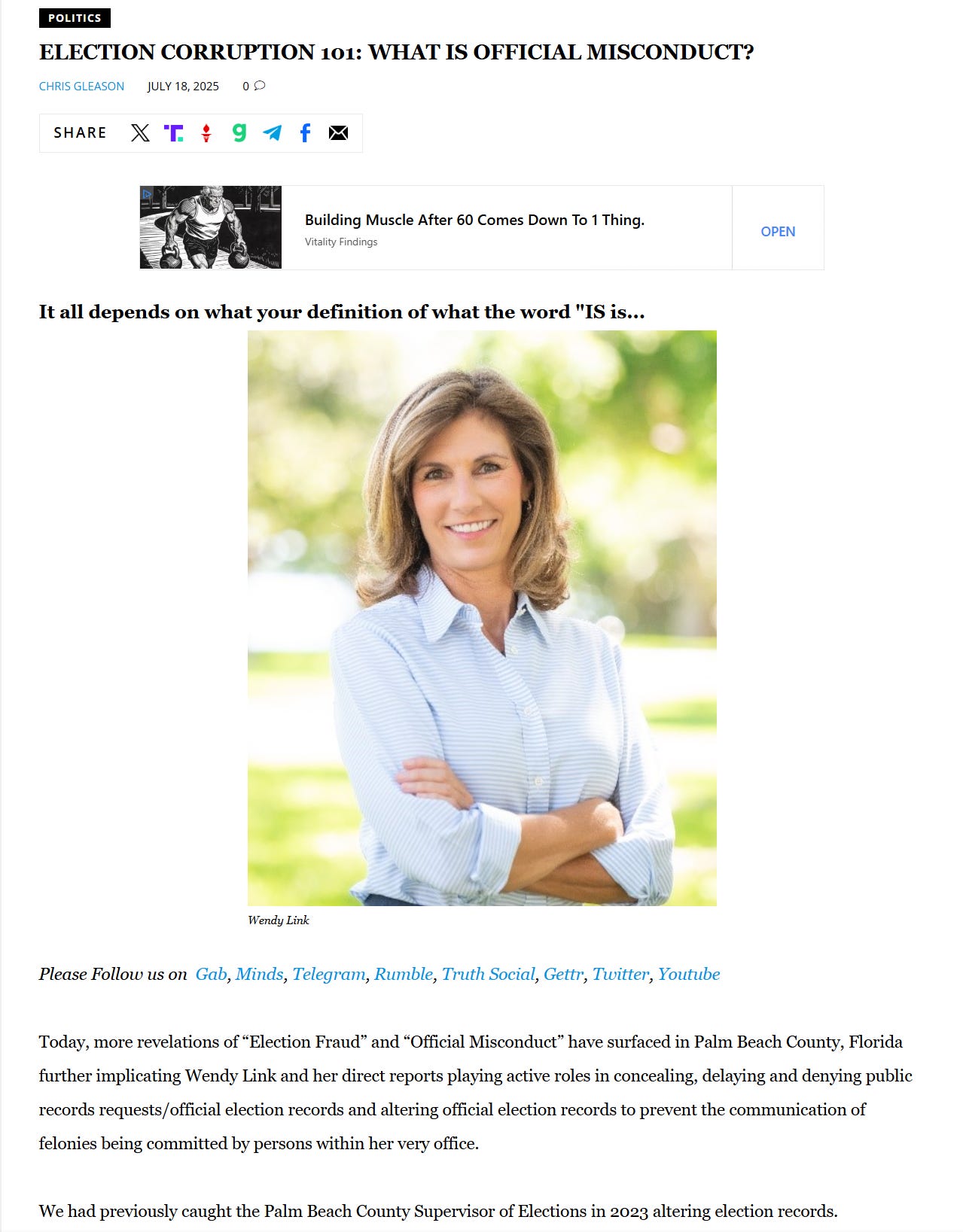
Same office. Same supervisor. Same pattern. Wendy Link's elections office is already facing six separate legal actions from three different plaintiffs across four election cycles, accused of backdating computers to 1984, altering federal election records, physically assaulting observers, and obstructing discovery. Now her volunteer is in handcuffs. When does the forensic audit start?
On Saturday evening, March 28, 2026, Palm Beach County Sheriff’s deputies executed a search warrant at the Lake Worth, Florida home of John D. Panicci, a 59-year-old registered Democrat and volunteer at the Palm Beach County Supervisor of Elections Office.
What they found should concern every voter in America.
Deputies recovered a stolen encrypted access key from a voter registration terminal, along with what the Sheriff’s Office described as “a substantial amount of electronic and digital storage devices.” Panicci was transported to the Palm Beach County Jail and booked on charges of grand theft and property crimes involving the taking or damaging of computer equipment. At his first court appearance on Sunday morning, a judge ordered him to have no contact with the Palm Beach County Supervisor of Elections Office and set bond at $6,000.
The theft occurred on March 19, during a volunteer training session at the elections office at 4301 Cherry Road in West Palm Beach. Five days later, on March 24, the special election for Florida House District 87 was held. Five days after that, on March 27, the elections office finally reported the equipment missing.
Let that timeline sink in.
The key was stolen five days before the election. The theft was not reported until three days after the election. That is an eight-day gap in the chain of custody of sensitive election infrastructure.
And in the election held during that gap? Democrat Emily Gregory defeated Trump-endorsed Republican Jon Maples by exactly 797 votes, flipping a district that President Trump carried by 11 points in 2024, and that the previous Republican incumbent won by 19 points. It was the first time a Democrat had won this district in this century.
Officials have stated that the stolen key was “configured only for training databases.” In the same breath, however, authorities acknowledged their concern that someone with technical expertise could potentially reverse-engineer the encryption and reintroduce it into a live voter registration kiosk for malicious purposes. That is not a reassurance. That is an admission of vulnerability.
And that phrase, “a substantial amount of electronic and digital storage devices,” deserves more attention than it has received. Why does a volunteer poll worker have a house full of digital storage hardware? What data was on those devices? Were any of them connected to election systems? These are questions that remain unanswered.
The HD-87 Election: A Statistical Anomaly
The March 24 special election results demand scrutiny independent of the Panicci arrest.
Florida House District 87 runs up the coast through Palm Beach Gardens, Jupiter, Juno Beach, and Hypoluxo. In 2024, Republican Mike Caruso won reelection by 19 percentage points. President Trump carried the district by roughly 9 points in 2024. The district has been reliably Republican for decades.
On March 24, 2026, in a low-turnout special election (28.82% voter turnout, 33,470 ballots cast out of 116,128 registered voters), Democrat Emily Gregory defeated Republican Jon Maples 17,113 to 16,316. That is a swing of approximately 21 points from the 2024 performance, in an election where roughly 13,000 of the 33,470 ballots were cast by mail.
Nearly 39% of all ballots in this election were vote-by-mail. That is relevant because vote-by-mail integrity is the central issue in the active litigation against the woman who administered this election: Palm Beach County Supervisor of Elections Wendy Sartory Link.
Democrats immediately seized on the result as a national narrative. DNC Chairman Ken Martin declared, “If Democrats can win in Trump’s backyard, we sure as hell can win anywhere across the country.” The Democratic Legislative Campaign Committee crowed that “Mar-a-Lago just flipped red to blue.”
Nobody mentioned that five days before the vote, a registered Democrat volunteer had stolen an encrypted election key from the same office that administered the election.
It is also worth noting that the North Palm Beach municipal race on the same ballot has already triggered a recount, per the Palm Beach County SOE website. The integrity of March 24 is not a settled matter.
The Wendy Link Problem: Six Legal Actions, Three Plaintiffs, Four Election Cycles, One Pattern
The Panicci arrest did not occur in a vacuum. It occurred in an elections office that is the subject of what may be the most concentrated litigation campaign against any single Supervisor of Elections in Florida history. At minimum, six separate legal actions involving at least three different plaintiffs, spanning the 2018, 2020, 2022, and 2024 election cycles, have been brought against Wendy Sartory Link or her office.
The mainstream press has treated each of these cases as isolated, disconnected events. They are not. Taken together, they reveal a pattern of conduct that is consistent across years: obstruct discovery, deny public records, alter evidence when cornered, and use taxpayer money to litigate against the citizens who catch you.
1. Scott v. Palm Beach County SOE (2018)
The earliest recorded legal action against Link’s office involves the processing of absentee ballots during the 2018 election. A lawsuit for declaratory and injunctive relief challenged Link’s office for violating Florida Statute 101.5614(4)(a). Specifically, Link’s staff was accused of determining which “overvoted” or “undervoted” absentee ballots contained “valid votes,” a power that belongs exclusively to the Canvassing Board under Florida law. The complaint further alleged that the plaintiff’s representatives were effectively barred from making any substantive observation of the ballot duplication process, in direct violation of Florida’s transparency requirements.
This matters because it establishes that the pattern of obstruction and overreach did not start in 2024. It started the year before Link even took office, and continued under her watch from her first days.
2. Christine Scott v. DeSantis, Wendy Sartory Link, et al. (Case No. 1D21-1530, Florida First DCA; related: 20-3253, 21-2938, 1D2023-0911)
Christine Scott, a candidate for U.S. House District 22, filed a petition naming Governor Ron DeSantis, Secretary of State Laurel Lee, Representative Ted Deutch, Division of Elections Director Maria Matthews, Wendy Sartory Link as Palm Beach County SOE, and Peter Antonacci as Broward County SOE. The case challenged election administration practices across the 2020 cycle.
What makes the Scott litigation significant is its persistence. Scott filed across multiple appellate proceedings at the First DCA (Case Nos. 20-3253, 1D21-1530, 21-2938, and 1D2023-0911), demonstrating that the issues she raised were not resolved but rather stonewalled through procedural attrition. This is the same strategy Link’s office would later deploy against Buongiorno: delay, obstruct, exhaust the challenger’s resources, and declare victory when they run out of money.
3. Darlene Swaffar v. Florida State Canvassing Commission (Case No. 2022-CA-001601, Leon County Circuit Civil Division)
Darlene Swaffar, a Republican candidate for U.S. Congress FL-23 (a district covering the southern portion of Palm Beach County and northern Broward County), filed her election integrity complaint against the Florida State Canvassing Commission on September 19, 2023. Swaffar alleged that election results in her 2022 race were not properly collected, processed, and counted. Her private investigations discovered inconsistencies and abnormalities in voter records, voter data, election code, and voting machines, including vulnerabilities in the voting machines themselves.
The discovery requests in Swaffar’s case are a forensic roadmap. She sought 26 specific categories of evidence including: voting system reports, voting system audit logs, ES&S Tabulator data, EVS records, Election Manager Reporting Manager documents, Electionware software data, and ES&S Event Log Service Audit Logs. This is exactly the granular tabulator and audit log evidence that Buongiorno was systematically denied by Link’s office in Palm Beach County, while Hillsborough County produced equivalent records for $1,855.47 upon routine request.
The Swaffar case demonstrates that the election integrity problems are not confined to a single race or a single disgruntled candidate. A completely separate plaintiff, in a completely separate election, in a district that overlaps Palm Beach County, independently identified the same categories of anomalies and sought the same categories of evidence.
4. Buongiorno v. Link, Federal (S.D. Fla., before Judge Aileen Cannon)
Jeff Buongiorno filed a federal lawsuit naming Wendy Link, then-Homeland Security Secretary Alejandro Mayorkas, and other federal and state officials as defendants. The complaint alleged a conspiracy to influence elections by registering non-citizens and synthetic identities as voters. The case was assigned to Trump-appointed U.S. District Judge Aileen Cannon. The federal complaint challenged the fundamental integrity of Palm Beach County’s voter rolls, not merely the mechanics of a single election.
5. Buongiorno v. Link (Case No. 50-2024-CA-011351, Palm Beach County Circuit Court, 15th Judicial Circuit)
This is the most evidence-dense case in the portfolio, and it is still active. Jeff Buongiorno, who ran against Link for Supervisor of Elections in 2024, filed an election challenge under Florida Statute 102.168 after the November 2024 general election. Buongiorno won in-person votes by nearly 9,000 votes. After vote-by-mail ballots were counted, the outcome flipped to Link.
The allegations and evidence from this case are staggering in their specificity:
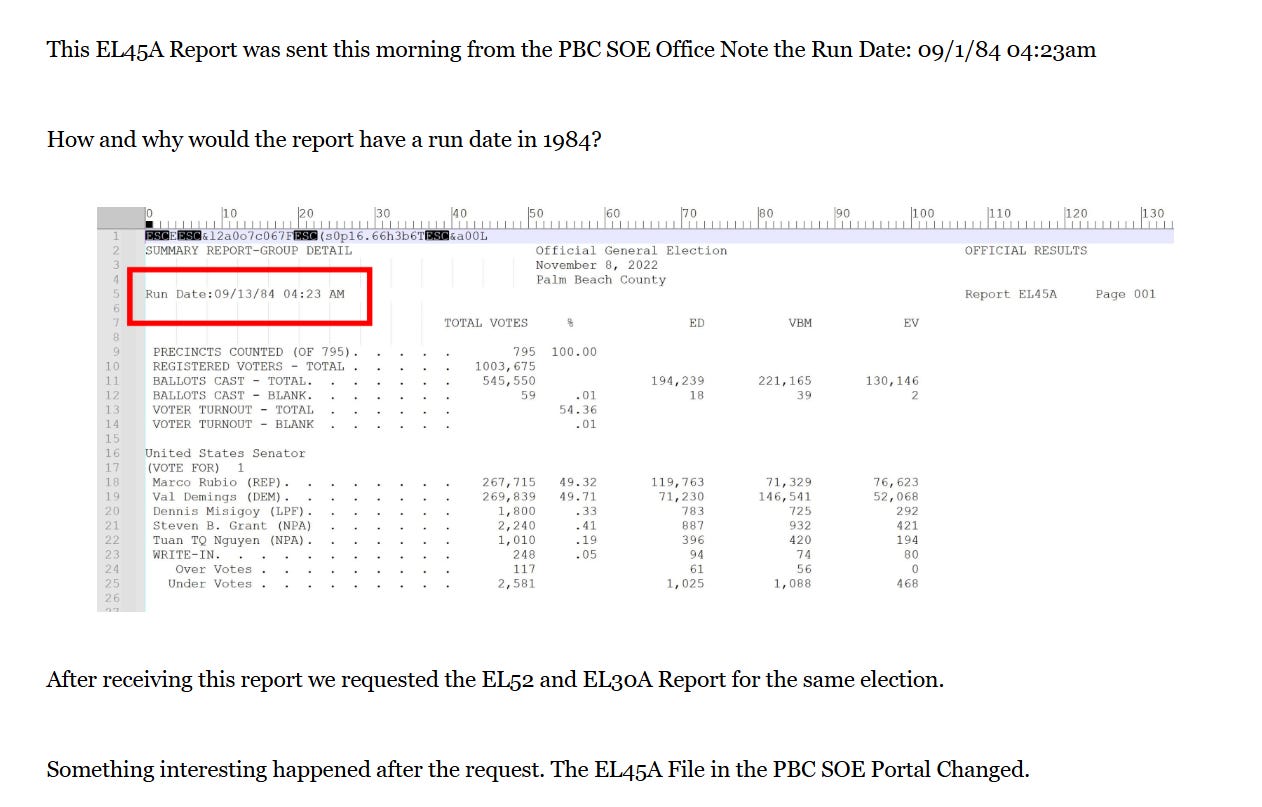
Altered Federal Election Records. Link’s office, or someone with system access within it, manually altered 14,084 official election records between November 5 and November 7, 2024. When the alteration was discovered, someone within the office backdated the system clock on the computer used to generate official election records to September 13, 1984, to evade detection in the audit logs. This is not an allegation of sloppy bookkeeping. This is digital forensic evidence of deliberate, knowing falsification of federal election records and subsequent evidence tampering to conceal the falsification.
Systematic VBM Fraud. The complaint documents that 19,649 vote-by-mail ballots were issued without the required identification verification mandated by Florida Statute 101.62. Of those, 16,657 illegal ballots were counted. Fraud detection systems within the elections office were disabled for 436 out of 516 days, and 225,845 ballots were cast on days when no fraud controls were active.
Obstruction of Public Records. Buongiorno submitted lawful public records requests for EL30, EL45, EL52, and EL68A audit logs, which are essential to any independent verification of tabulation accuracy. Link’s office denied access to all of them. Hillsborough County routinely maintains, processes, and discloses the identical EL68A logs. The only difference is that Hillsborough County is not trying to hide what those logs contain.
Judicial Irregularities. Circuit Court Judge Maxine Cheesman, who initially presided over the case, subsequently disqualified herself based on procedural irregularities and judicial bias. Buongiorno filed for a mistrial based on judicial misconduct, including witness intimidation by defense counsel Gregor Schwinghammer, Judge Cheesman, and Deputy Sheriffs.
Taxpayer-Funded Personal Defense. Link sought to increase the Palm Beach County Supervisor of Elections litigation fund to underwrite her personal legal defense. This directly violates Florida Statute 111.07 and is contrary to AGO 77-87, which explicitly states that neither county funds nor the supervisor of elections’ office budget may be used to defend a supervisor in an election contest under section 102.161 F.S. The Attorney General’s opinion clarifies that such litigation is “personal to the candidates involved” and does not serve a public purpose. The defense of these cases has cost Palm Beach County taxpayers nearly $250,000.
Emergency Motion to Preserve Evidence. On March 30, 2025, Buongiorno filed an Emergency Motion for Temporary Injunction to Preserve Official Election Records and Permit Forensic Review. The motion sought to prevent the destruction, alteration, or overwriting of digital election records, log files, ballot images, system memory cards, and tabulation-related metadata. The motion was denied.
Down-Ballot Anomaly. Perhaps most remarkably, Wendy Link received more votes in the 2024 Palm Beach County Supervisor of Elections race than either Donald Trump or Kamala Harris received in the county for President. A down-ballot SOE race outperforming both presidential candidates is a statistical red flag that warrants independent forensic examination.
6. Physical Assault of Election Integrity Observer (March 10, 2026)
On the evening of March 10, 2026, during the Palm Beach Gardens municipal election, an election integrity advocate was physically assaulted by subordinates of Wendy Link’s office. A staff member reached into a public area and grabbed and pushed the observer backward by her upper arm. Police reports were filed with the Palm Beach Gardens Police Department. Multiple witness statements are available, including from at least one volunteer for a municipal candidate who witnessed the assault.
This occurred just 14 days before the March 24 HD-87 special election where the Panicci theft took place. This was not an isolated event. Link’s office has a documented history of physical intimidation of observers. In September 2024, a Palm Beach County woman was physically removed by two sheriff’s deputies from a pre-canvassing meeting for asking questions about two different types of ballot paper being used. Link was present and did not intervene.
The Pattern
Lay these events on a timeline and the pattern is unmistakable:
2018: Link’s office violates ballot processing transparency requirements. Lawsuit filed.
2020: Christine Scott challenges election administration in Palm Beach County. Link named as respondent. Multiple appellate proceedings follow through 2023.
2022: Darlene Swaffar discovers voting machine vulnerabilities, voter data inconsistencies, and ES&S tabulator anomalies in Palm Beach County. Files suit against the State Canvassing Commission demanding audit logs.
2024 (Federal): Buongiorno files federal suit alleging non-citizen registration conspiracy. Assigned to Judge Cannon.
2024 (State): Buongiorno files election challenge. Discovers 14,084 altered records, system clock backdated to 1984, 19,649 ballots issued without ID verification, fraud detection disabled for 436 days, public records systematically obstructed.
September 2024: Observer physically removed from pre-canvassing meeting for asking about ballot paper. Link present, does not intervene.
March 10, 2026: Election observer physically assaulted by Link’s subordinates. Police report filed.
March 19, 2026: Panicci steals encrypted access key and equipment during volunteer training.
March 24, 2026: Democrat wins HD-87 by 797 votes in 21-point swing.
March 27, 2026: Theft finally reported. (Three days after the election.)
March 28, 2026: Panicci arrested. “Substantial amount” of digital storage devices seized.
This is not a sequence of isolated incidents. This is the operational signature of an elections office that operates outside the law, obstructs anyone who notices, and retaliates against anyone who asks questions.
What Needs to Happen Now
The citizens of Palm Beach County, and the people of the State of Florida, are entitled to answers.
The March 24, 2026 special election in HD-87 should be subjected to a full forensic audit. Every digital storage device seized from Panicci’s home should be forensically examined, and the results should be made public. The Panicci investigation should be expanded to determine whether he acted alone or was part of a coordinated effort.
A special grand jury investigation under Florida Statute 104.43 is warranted. The evidence presented in Buongiorno v. Link alone, specifically the altered records, the backdated system clock, the disabled fraud detection, and the systematic obstruction of public records, meets the threshold for investigation of violations of F.S. 104.047 (fraudulent or corrupt official election actions), F.S. 838.022 (official misconduct), and potentially federal election crime statutes governing the alteration of federal election records.
Governor DeSantis appointed Wendy Link. He has the authority to suspend her. The evidence is now overwhelming that Palm Beach County’s elections are not being conducted in accordance with Florida law.
Three different plaintiffs. Four election cycles. Six legal actions. One arrest. And 797 votes that may have changed the trajectory of Florida politics.
The people of Palm Beach County deserve a Supervisor of Elections who follows the law. Right now, they have one who is alleged to have broken it repeatedly, systematically, and with impunity.
That ends when the people demand it ends.
Until there is enough public outrage Wendy Link’s official misconduct, breach of public trust within the walls of her Palm Beach County Fortress of Election Fraud will continue. The people of Palm Beach County to include it’s most famous voter and the man whose own election was stolen in Palm Beach County need to demand a full 100% audit and a Special Grand Jury Investigation must be initiated.
The evidence is irrefutable. We caught Wendy Link dead to rights numerous times going back several years now.
Q: How do you legally certify, illegally administered elections?
A: ILLEGALLY… THROUGH OFFICIAL MISCONDUCT